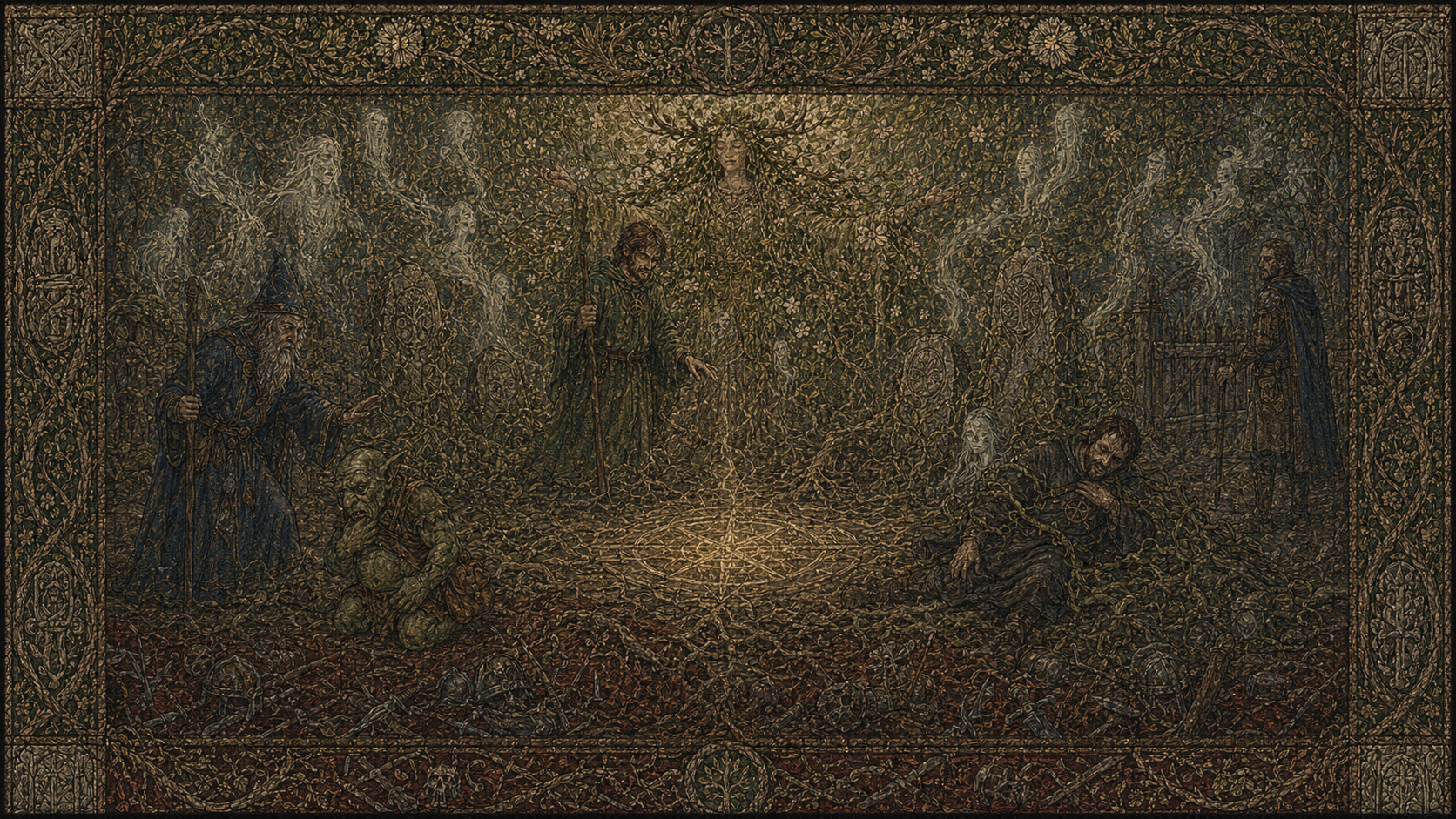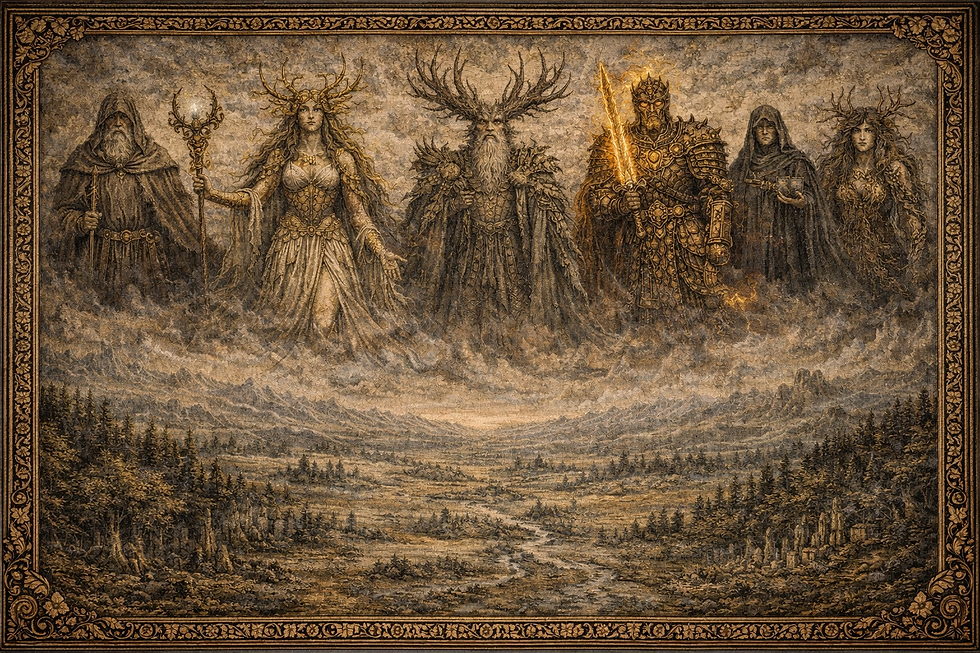
The Pantheon of Druidaine
A Codex of the Eight Gods
The gods of Druidaine dwell primarily within the spirit realm, yet their influence reaches into the living world through faith, ritual, sacrifice, memory, spirits, and runes. They may appear in many forms and may cross into any realm, though full divine intervention always carries consequence. Their power is strongest where mortals align with their nature rather than merely speak their names.
There are eight gods in the known pantheon: Orldan, Freyvara, Morveth, Volkrim, Giorth, Tyrakhel, Aestrael, and Caelthryn. Their histories are inseparable from the rise of the Druids, the wound between the living and spirit realms, and the long struggle to preserve balance after an ancient divine and mortal error.
Orldan — King of the Gods
Spiritual Form: Male
Divine Generation: Second generation
Current Rank: King of the Gods
Domains: Wisdom, recognition, foresight, restraint, mediation, balance, sovereignty, sacrifice,
rune worship
Patron Of: Druids, Seers, oaths, watchers, rune priests
Sacred Relic: The Eye of Orldan — a reflective iron-glass sphere, conduit, and lens
Common Symbols: The single eye, the staff, the watching tower, the rune circle, the cloaked elder
Sacred Virtues: Recognition, restraint, service, sacrifice, humility before truth, decisiveness
I. Main Attributes
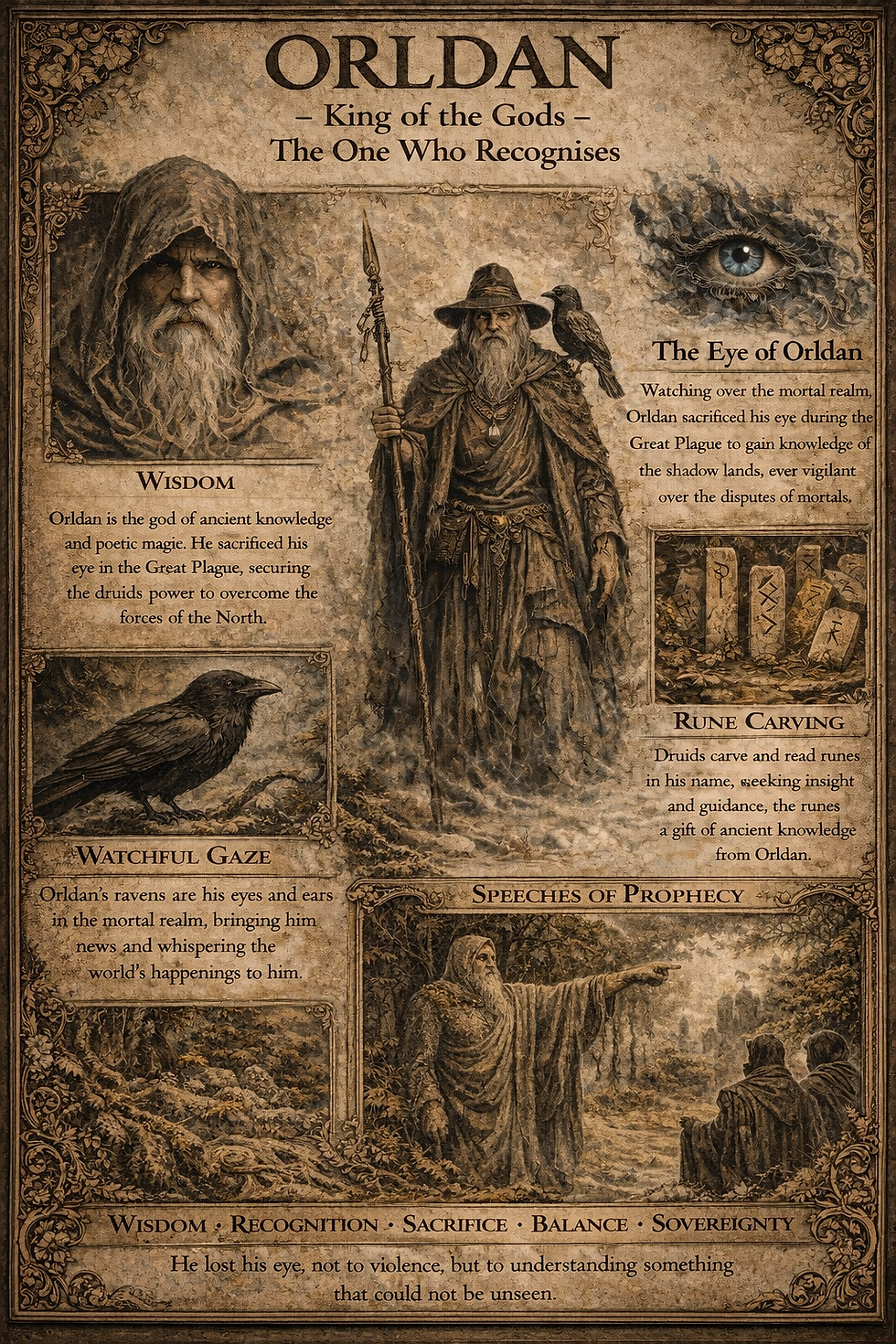
Orldan stands at the centre of modern divine order. When the living realm buckled under spiritual pressure and the Great War tore Druidaine apart, he gave his eye and cast it into the mortal realm. That eye became the Eye of Orldan, a sacred conduit through which divine sight could look upon the world.
His domain is often misunderstood by common worshippers. Orldan is a god of wisdom, yet wisdom in Druidaine is rarely gentle. It is the ability to see a thing truly, even when that truth wounds the soul. He is also a god of recognition. His power flows when the proper nature of a person, place, spirit, wound, or covenant is acknowledged. A false king may command. Orldan understands.
His authority is closely tied to the Druids. They began as mediators between spirit and nature, formed among humans influenced by proximity to Elven magic and the spirit-rich lands of the Eldrich Forest. Over time, Orldan became their chief patron. True Druids listen to all gods, yet all swear fealty to the King of the Gods as part of their post-war tradition.
Orldan’s worship is quiet and disciplined. His followers honour him through vigils, rune-carving, journeys of service, acts of restraint, and sacrifices of comfort, pride, status, or certainty. His rites favour action after revelation. A person praying to Orldan often asks to see clearly, to act rightly, or to hold steady when the proper path remains hidden.
Among Druids, Orldan’s worship is woven into training. An initiate may study lore, healing, runes, history, diplomacy, spirit-sense, and the natural world, yet final recognition comes through a pilgrimage of faith. Orldan’s blessing traditionally marks the threshold between trained initiate and true Druid. A person may know every rite and remain unrecognised if faith, humility, and service are absent from their work.
II. Nature and Character
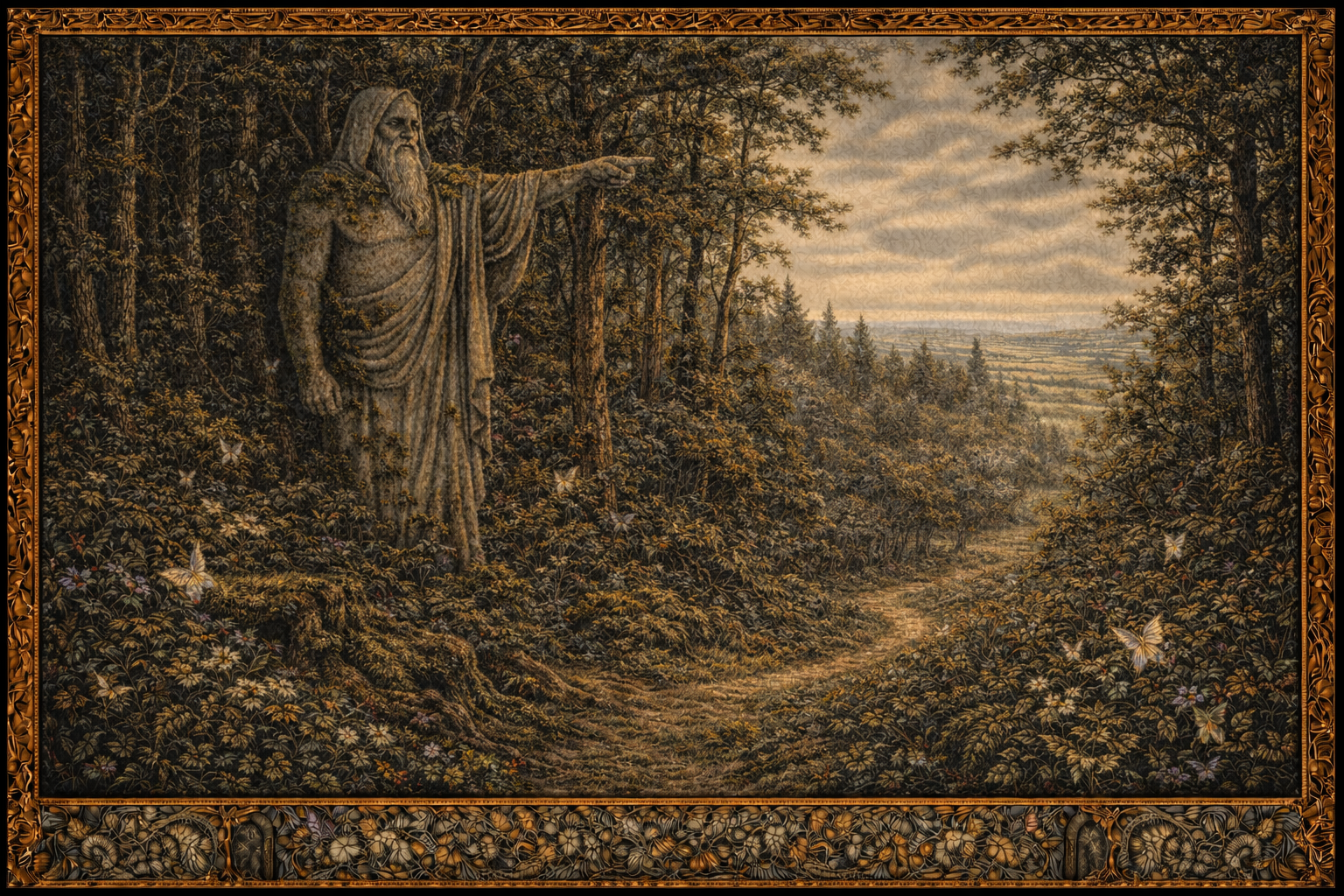
Orldan is calm, distant, solemn, and burdened. Old tales depict him as a tall, elderly figure with a flowing beard, a single eye, a cloak, a wide-brimmed hat, and a staff or spear. The spear belongs to his iconography as a carried object of authority; the Eye of Orldan remains the reflective iron-glass sphere.
He speaks rarely. When he speaks, the spirit world opens, and his words reveal what remains hidden from the mortal realm. His power is less like command and more like unveiling. Hidden things become seen. Unstable spirits feel judgement return through their own nature. Runes placed under his name answer when the act behind them is faithful to his version of balance.
Orldan values restraint because the Great War proved that unchecked power can masquerade as salvation. The Dark Druid King believed the ancient silence of the heavens proved divine weakness. In truth, his own rituals strained the boundary between worlds. Orldan’s tragedy began when he recognised too late that Caelthryn’s enforced restraint had become complicity. His sacrifice marked the moment divine restraint gave way to divine action, beginning the gods’ attempt to rebalance the two realms.
Toward the Druids, Orldan is often fatherly. Myths sometimes claim Druidic blood descends from him, though this remains symbolic rather than literal. The connection has spiritual merit: true Druids carry his trust, his burden, and his shame.
III. Worship and Daily Life
Ancient runes from the Second Age were created when the gods were distant and mortal faith was pure.
They still respond to sacrifice, devotion, service, and correct alignment, even when badly maintained in the current age. Many survive in ruined temples, buried groves, covenant towns, and forgotten roads.
Common people pray to Orldan before difficult judgments, journeys, oaths, trials, and moments where a leader must choose duty over desire. Rulers invoke him when swearing to serve nations rather than exploit them. Seers seek his steadiness when visions threaten to conjure dangerous paths.
The old phrase “Orldan’s gaze watches over us all” remains common in Druidaine. It is comfort, warning, and oath.
IV. Divine Ties
Orldan is the son of Caelthryn and Freyvara, born of endurance and life. From Caelthryn he inherited patience, distance, and restraint. From Freyvara he inherited care for cycles, living balance, and the need to provide.
His relationship with Caelthryn defines the current divine order. Caelthryn was the Old King of the Gods and Orldan’s father. When Orldan’s sacrifice revealed that balance in the mortal realm required divine interference, Caelthryn acknowledged his wisdom, and the crown passed.
Orldan understands Freyvara and Morveth more deeply than most gods. Their twin nature cannot be solved through simple victory. Freyvara governs life that cycles and releases. Morveth governs life that clings and rots. To destroy either entirely would imperil the meaning of the other. Orldan therefore maintains balance between them, even when the cost is harsh.
With Tyrakhel, Orldan shares concern for order, though Tyrakhel seeks law where Orldan seeks recognition. With Volkrim, he shares respect for truth, though Volkrim finds truth through open violence. With Giorth, Orldan stands against bargains, excess, and manipulation. With Aestrael, he shares quiet kinship through memory, thresholds, spirits, and secretive knowledge.
V. Historical Lore
Orldan’s rise cannot be separated from the Great War of the Dark Druid King. In the First Order and Early Mortal Ages, the gods remained distant but responsive through mortal ritual, faith, and alignment. Druids emerged as conduit mediators, designed to harmonise spirit and nature rather than rule over either.
The Dark Druid King changed this. He began as a figure of extraordinary devotion, learning rites to all gods and studying the mechanics of sacrifice, power, and divine response. Eventually, worship turned into interference. He sought dominion over spirit, nature, and gods, believing the divine silence he witnessed proved their weakness. His rituals increased spirit pressure, fractured Druidic circles, and turned mortal faith into banners of war.
Some Druids clung to Orldan’s restraint. Others turned to Freyvara’s abundance, Volkrim’s war, or Morveth’s decay. Human and Elven followers entered the conflict. The North suffered plague, famine, war, and spiritual corruption. Two thirds of its population perished.
At the height of this catastrophe, Orldan tore out his eye and cast it into the world. The act allowed him to see into the living realm beyond Caelthryn’s restraint. The gods recognised the truth of his sacrifice. Upon witnessing the destruction of the mortal realm, divine power changed, and Orldan became King of the Gods.
The Eye of Orldan remains central to the present story. It can grant sight across the mortal realm, though some places remain hidden by manipulation. It can heal spiritual wounds, aid covenant towns, interact with runes, and serve as a focus through which Orldan’s recognition touches the world. Its purpose is guidance, stabilisation, and foresight rather than domination.
VI. Orldan and the Druids
The Druids are Orldan’s most important mortal order. Their connection began before his kingship, yet became sacred after his sacrifice. They are advisers rather than rulers, mediators rather than conquerors, and servants of balance rather than owners of magic.
A true Druid is expected to listen to all eight gods, understand the spirit realm, respect natural forces, preserve runes, guide settlements, and avoid the old error of command over spirits. They wield magic only when allowed by divine alignment, faith, sacrifice, or correct recognition. Misused magic scars the soul. Abused magic corrupts the soul.
Orldan’s relationship with the Druids remains both honour and warning. Their greatest glory and greatest shame came from the same source: the belief that mortals could stand between gods and world. Orldan preserved them because their purpose remains necessary. Yet he watches over them because their failure once broke the world.
Freyvara — The Mother of Cycles and Light of Life
I. Main Attributes
Spiritual Form: Female
Divine Generation: First generation
Domains: Life, fertility, food, water, birth, healing, renewal, forests, growth, abundance,
natural cycles, proper death, ancestral return
Patron Of: Bakers, farmers, healers, mothers, woodland peoples, Ents, goblins, those who care for others
Sacred Symbols: The rooted tree, vines, flowers, flowing water, bread, spring,
circular tree medallions showing roots and branches
Sacred Virtues: Nourishment, renewal, release, fertility, generosity, care, seasonal wisdom, cyclical balance
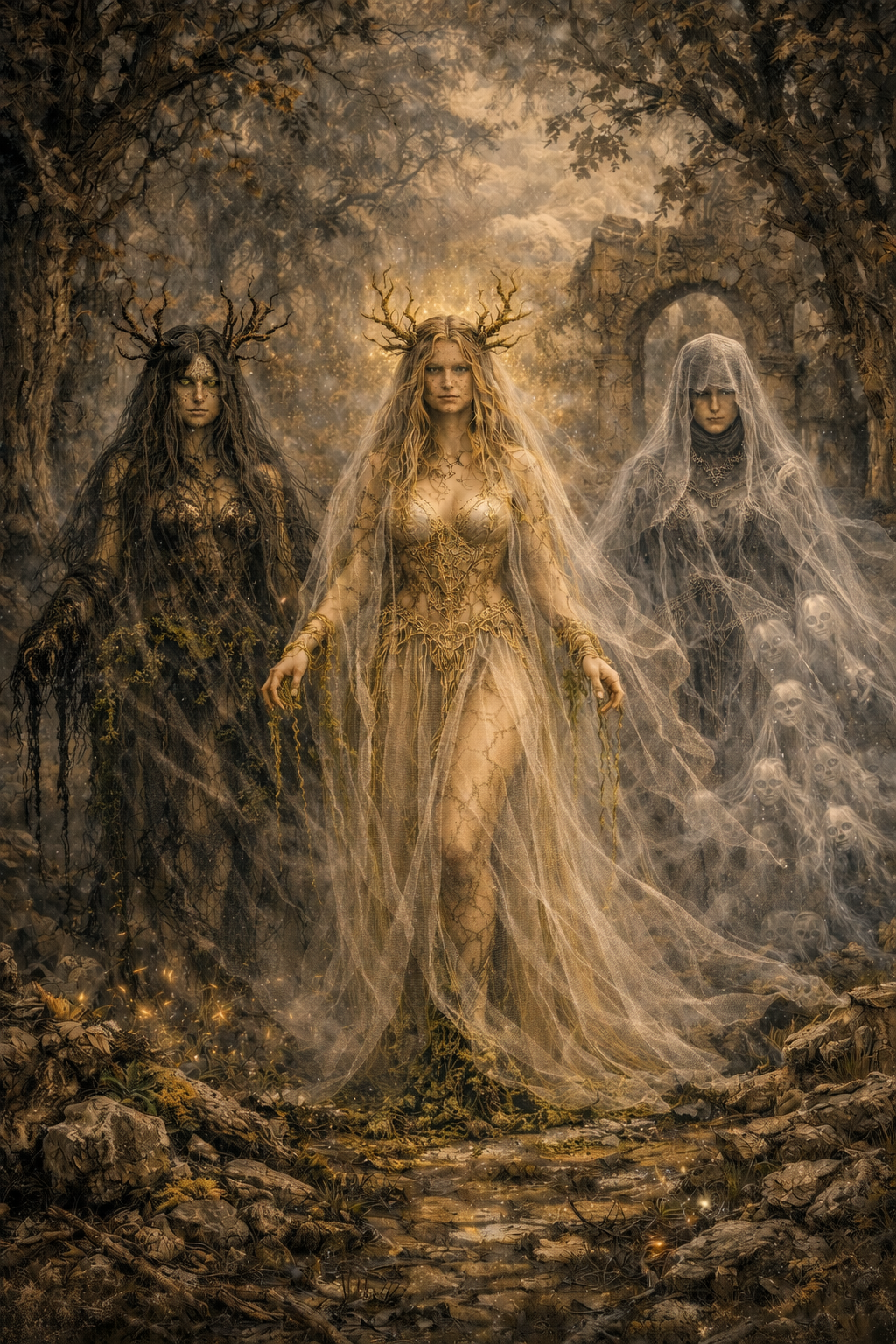
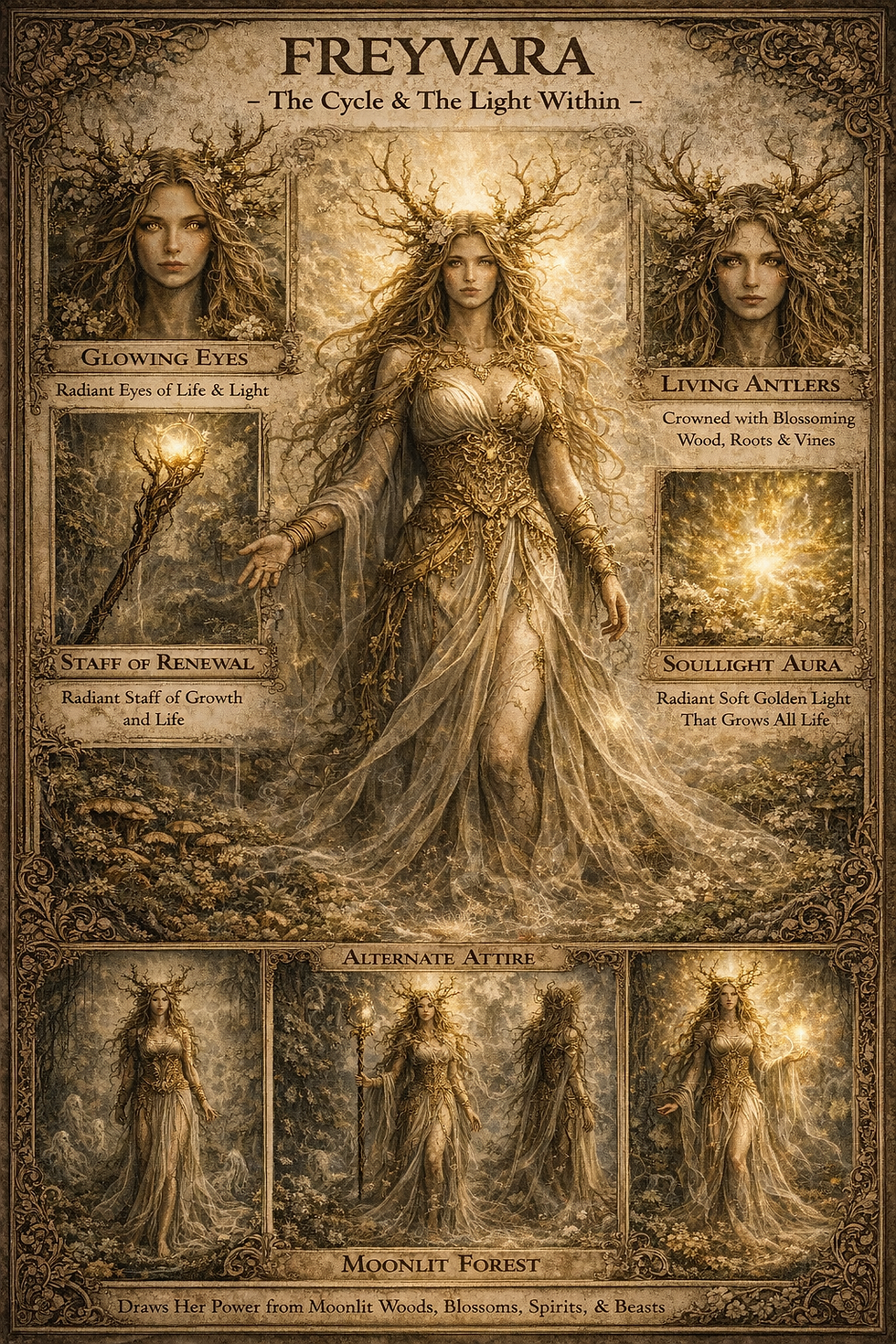
Freyvara is one of the first gods and twin sister of Morveth. Together, the sisters define the deepest law of life and death in Druidaine. Freyvara governs life that moves, grows, feeds, dies, returns, and rises again in proper season. Her power is seen in fields after rain, a mortal’s first breath, food shared at a table, clean water drawn from old springs, and forests that talk.
She is often called the Giver Who Cycles because she offers abundance and then recedes. Life under Freyvara is never fixed in one form. It becomes seed, flesh, fruit, rot, soil, memory, and new growth. Her worshippers understand death as part of her mercy when death comes in its proper hour and the spirit is released into the right passage.
Freyvara holds immense importance in living human memory. During the Age of Confidence, many humans viewed the flourishing of Druidaine as an Age of Freyvara. Ents walked from forests into settled lands. Crops thrived. Rowan Forest became a near-perfect harmonisation of spirit and nature.
II. Nature and Character
Freyvara is abundant rather than merely gentle. She is warmth, growth, and nourishment, yet she also understands when to let go. Her kindness has roots. Her mercy has seasons. Death belongs to her cycle as surely as birth.
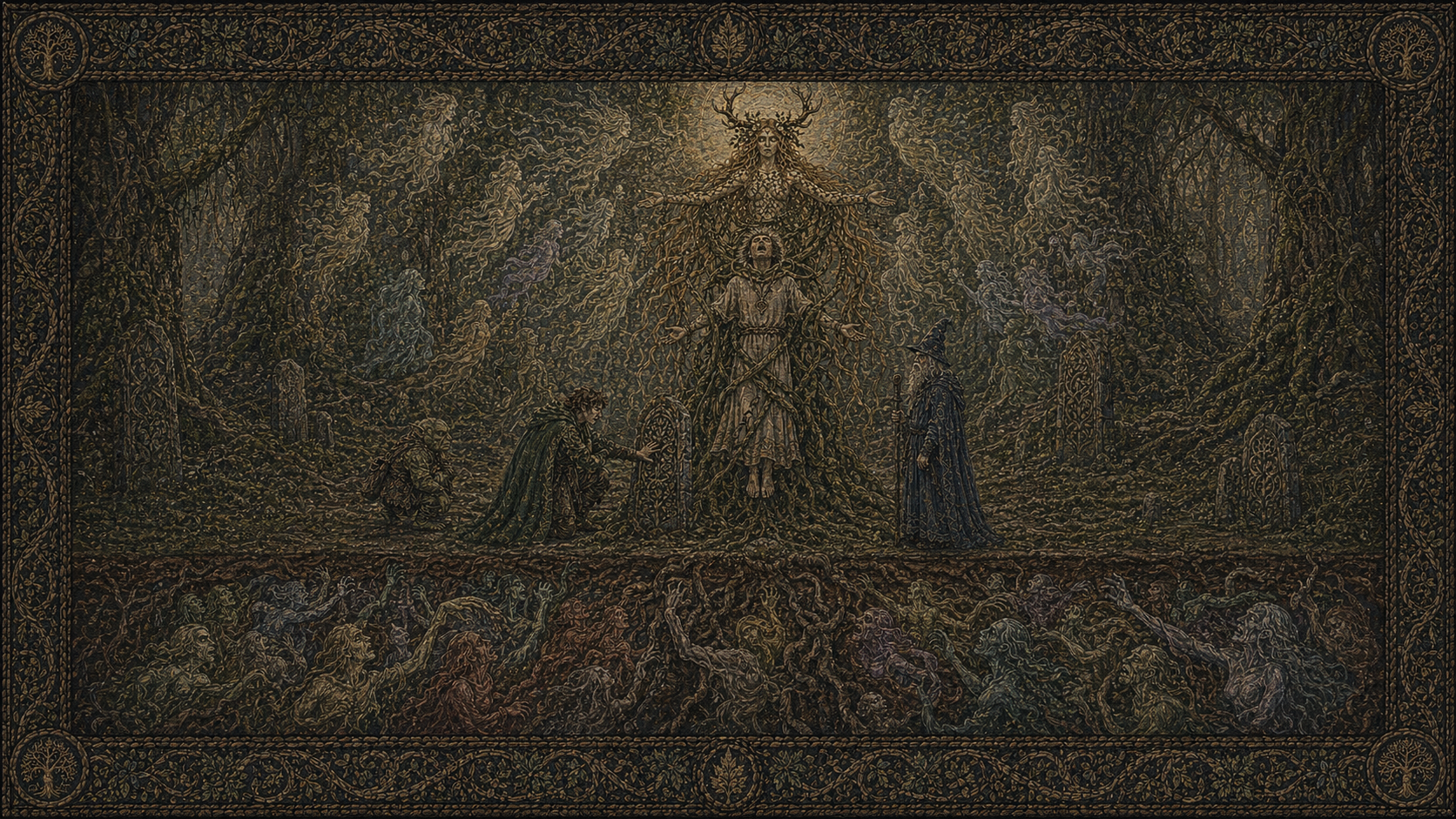
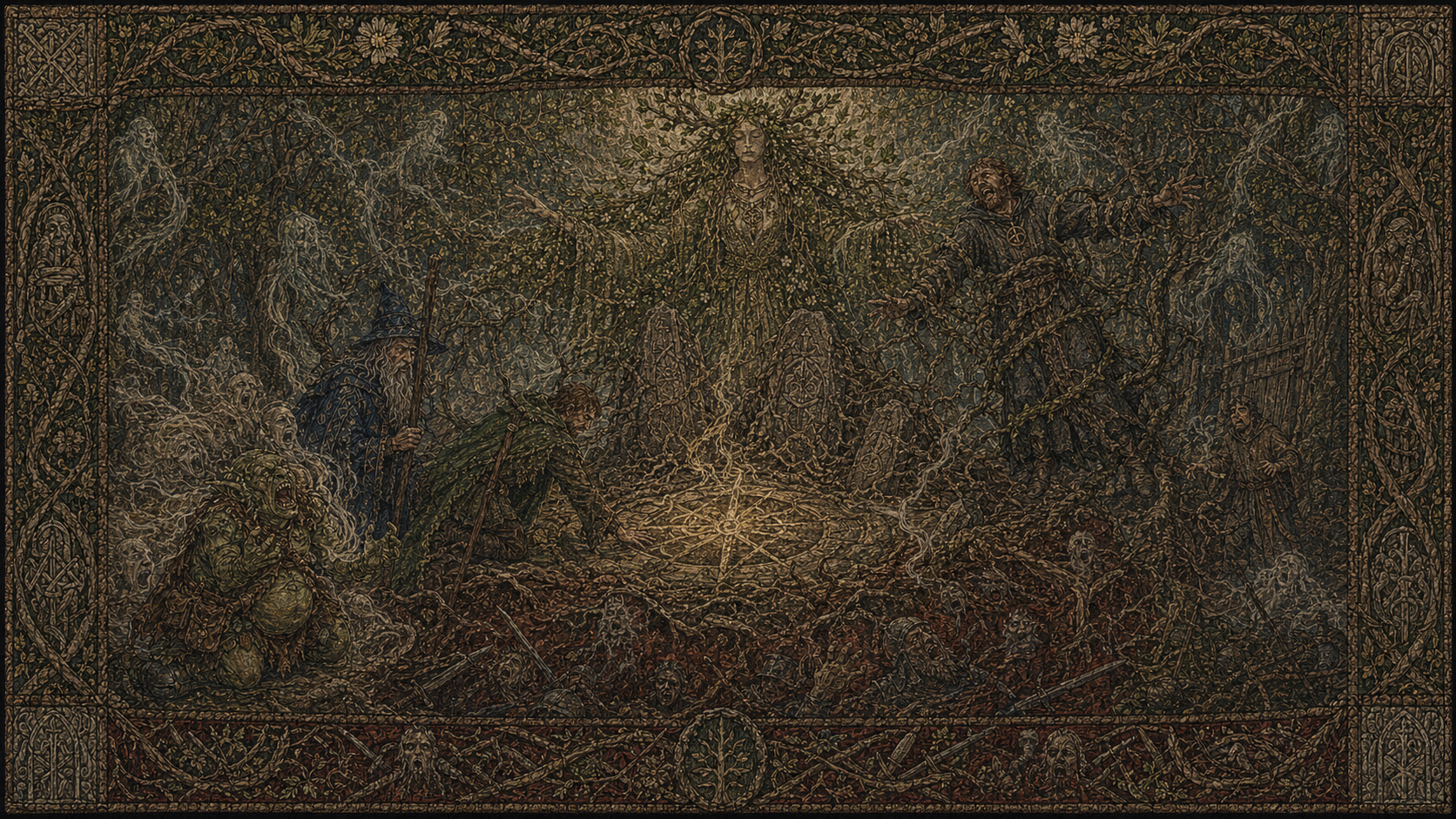
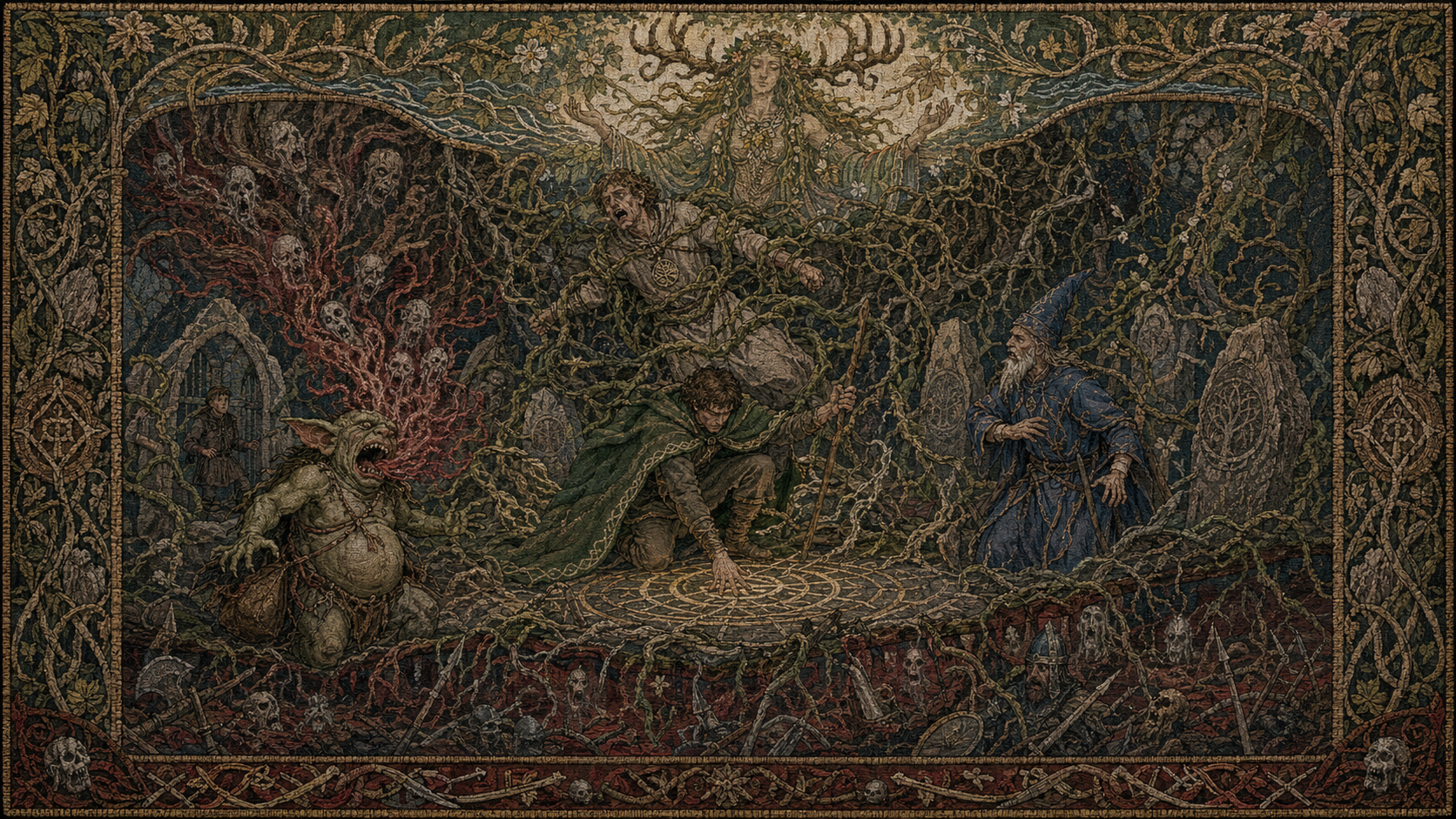
Her presence can appear in many forms: an antlered goddess wrapped in earth-toned garments and vines; a motherly figure of harvest; a forest-crowned watcher; or a quiet pressure in bread, water, and soil. Her sacred tree medallion, showing roots and branches, represents the living covenant between land, spirit, memory, ancestry, renewal, and the guiding of souls.
Freyvara’s magic often looks mundane before it reveals its power. Baking, brewing, feeding, washing, tending wounds, planting, and sharing food may all become spiritual actions under her. Schorla the baker embodies this pattern: her food magic restores, corrects, and protects rather than merely dazzles.
When Freyvaran magic heals, it aims to return a being to its proper place in the cycle. It brings back what Morveth removes, releases what Morveth traps, and restores what corruption has bent out of shape.
III. Worship and Daily Life
Freyvara is honoured through acts that enhance life. Baking bread, feeding travellers, tending crops, brewing, washing bodies, midwifery, healing, planting trees, maintaining wells, and preserving burial groves may all form part of her worship. A Freyvaran village often treats hospitality as sacred law. To feed another person is to imitate the goddess in miniature.
Farmers pray to Freyvara before sowing and harvesting. Healers invoke her before treating wounds. Bakers may dedicate the first loaf. Families may plant trees for births, marriages, and deaths. Water rites belong strongly to her, especially where rivers, wells, and old springs sustain towns.
Her worship also shapes the handling of the dead. In some covenant towns, Freyvaran priests maintain shrines that guide local spirits through to Freyvara’s part of the spirit realm. Halverin is the clearest present example. Its founding families were a Freyvaran restoration cult who settled upon the Rotting Fields centuries after the Great
War. Their purpose was service: maintaining rites so the dead beneath the land could pass gently rather than rise
in torment.
Freyvara’s followers live within seasonal rhythms. Their festivals may honour first fruit, spring rain, midsummer growth, and large harvests. True Freyvaran worship carries joy, yet also discipline. Abundance without stewardship turns wild. Growth without harvest becomes choking. Healing without release becomes corruption.
IV. Divine Ties
Freyvara’s most important divine bond is with Morveth, her twin. Their shared origin forms one of the pantheon’s central truths. They were born together as two conclusions of the same force, created when Caelthryn first shaped organic matter. Freyvara governs the cycle. Morveth feeds off it.
The sisters are inseparable. Their horror lies in their closeness. They undo each other’s work rather than simply wage war. Where Freyvara heals, Morveth infects. Where Freyvara feeds, Morveth starves slowly. Where Freyvara allows death, Morveth traps it and plays with it.
Freyvara sees Morveth as a necessary shadow: proof of what happens when life is hoarded. Morveth sees Freyvara as careless, letting go of what could be kept.
Freyvara is mother of Orldan, and through him her concern for living balance enters divine sovereignty. Orldan understands her deeply and fears the scale of her influence, because unchecked abundance can also destroy. During the Druidic civil fracture just before the Great War, some followers turned to Freyvara in desperation, trying to drown corruption in life. Forests surged. Crops grew wild. Villages were consumed by abundance beyond human capacity.
With Caelthryn, Freyvara shares an ancient foundation: endurance and renewal. With Aestrael, she shares care for souls at thresholds. With Tyrakhel, she underpins civil stability through food, health, and population. Volkrim respects her capacity to return soldiers to battle, though he resents wars extended beyond honest ending. Giorth feigns devotion to her when abundance profits him, while privately exploiting scarcity and decay when her presence fades.
V. Historical Lore
In the First Order, Freyvara and Morveth emerged as twin goddesses after Caelthryn, forming the early balance of life and death cycles. Freyvara embodied life, fertility, growth, and abundance. Morveth embodied decay, disease, rot, entropy, and disorder in nature. Their balance shaped the living world.
During the Age of Confidence, Freyvara’s influence flourished. Druidaine entered an age of growth under Druidic mediation and Elven guidance. Runes were placed across the land. Rowan Forest became a spiritual centre. Ents began to walk openly among humans and Druids. Many human traditions remembered this period as the Age of Freyvara, when mother-earth worship dominated much of Druidaine’s common faith.
Yet hidden Elven scriptures from the end of that age speak of plagues rising over thousands of years. Morveth was slowly fed by what Freyvara could no longer maintain under Caelthryn’s growing silence and refusal to intervene in the living realm. This set the stage for later disaster.
During the Age of Grievance, Druidic factions fractured by their differing faith. Some turned to Freyvara, desperate for life to drown out corruption. Their efforts produced both miracles and horrors. Forests swallowed settlements. Crops grew faster than they could be harvested. Life surged beyond plan.
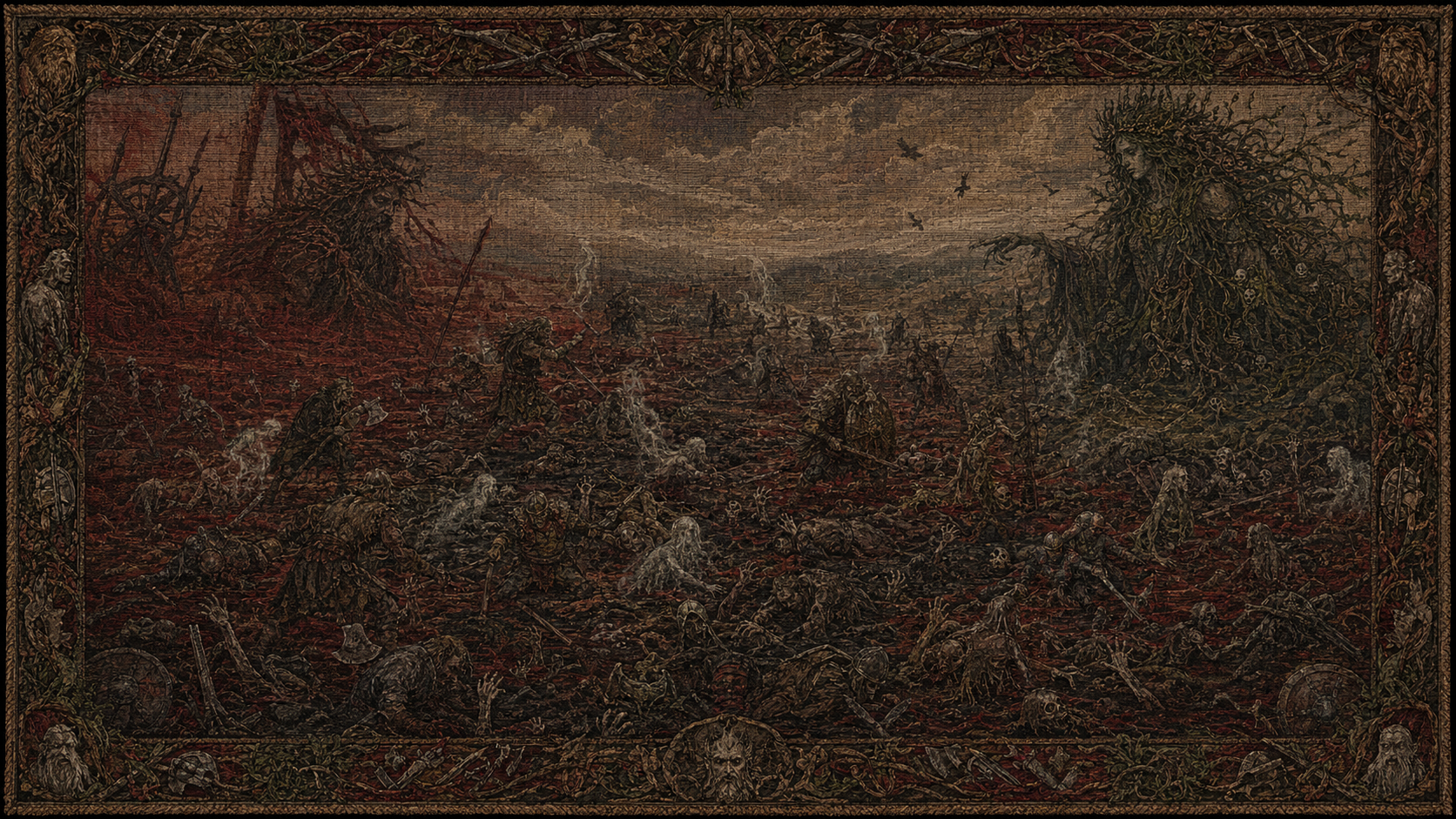
At the Battle of the Serpent Plain, Freyvara’s forces faced Morveth in the Black Orchard Marches. Freyvara’s white-cloaked heavy infantry, pike blocks, and blade-healers advanced through orchards heavy with fruit. They cut down Morveth’s re-forming forces for days, yet Morveth’s dead rose again, dragging Freyvaran soldiers into masses of meat, bark, blood, and sap. Freyvara’s host withdrew with ranks intact but numbers gutted. Morveth held the Marches.
In later ages, Freyvara’s restoration cults became essential to healing war wounds. Halverin preserves this legacy. Its grove, shrine, priesthood, and grave rites remain rooted in Freyvara’s ability to guide the dead through a gentler path.
VI. Freyvara, Ents, and Goblins
Freyvara is strongly linked to the Ents, who became sentient when her power saturated ancient waters. Ents are living witnesses of old growth, forest memory, and natural harmony. During the Age of Confidence, they walked from Rowan Forest and other sacred woods into human lands, often appearing near fields and townships before Druids arrived.
Ents are the land remembering itself. Where Freyvara’s influence remains strong, they may appear as guardians, witnesses, or slow-moving agents of renewal. Their presence marks spiritual harmony between nature and the spirit realm.
Freyvara is also associated with goblins, especially through food, resilience, and restoration. Goblins are among the earliest forest-dwelling peoples: ancient, clever, poor communicators, and spiritually resilient. Their shamans understood spirit-binding through food and gamble. Though many goblins later became vulnerable to corruption, their earliest nature belongs close to forest life, appetite, and survival.
The goblin companion’s restoration through Freyvaran food magic is therefore deeply symbolic. Schorla’s baking counters Morveth by restoring proper form and proper ending. Food becomes a sacred corrective. The act of feeding becomes spiritual realignment.
In Freyvara’s lore, nourishment is never small. A loaf of bread may carry more divine truth than a battlefield miracle.
Morveth — The Rot Below and Life That Clings
I. Main Attributes
Spiritual Form: Female
Divine Generation: First generation
Domains: Rot, decay, corruption, disease, stagnation, entropy, disorder in nature, unnatural death,
trapped spirits, unending life
Patron Of: The Fallen Elf, plague cultists, rot spirits, corrupted shrines, places where death has failed
Sacred Symbols: Twisted roots, fungal growth, blackened vines, diseased bark, swollen earth, stagnant pools
Sacred Virtues: Refusal, preservation, hunger, endurance through corruption, truth through rot
Morveth is Freyvara’s twin and one of the first gods. She is the most feared power in Druidaine because her domain begins where natural death loses its mercy. She governs rot, plague, lingering spirits, bodies that rise again, wounds that heal wrongly, and life that clings long past its rightful end.
Common villagers often mistake Morveth for a goddess of death. Older theology gives a darker answer: Morveth is a goddess of unending. Proper death releases the spirit, feeds the soil, and allows renewal. Morveth holds life in place until it curdles. She is the force of a corpse rising because enough flesh remains intact, a wound closing around infection, a spirit trapped beneath a battlefield, and a city surviving by feeding on those inside it.
Disease follows her worship. Plague is life out of harmony: flesh consuming itself, growth turning inward, healing losing measure, bodies becoming battlegrounds of hunger. Her horror comes from life refusing to let go.
II. Nature and Character
Morveth is patient, calm, severe, and ancient. Her corruption spreads quietly. Neglect, fear, hoarded power, grief, greed, and spiritual abandonment can feed her more effectively than open worship.
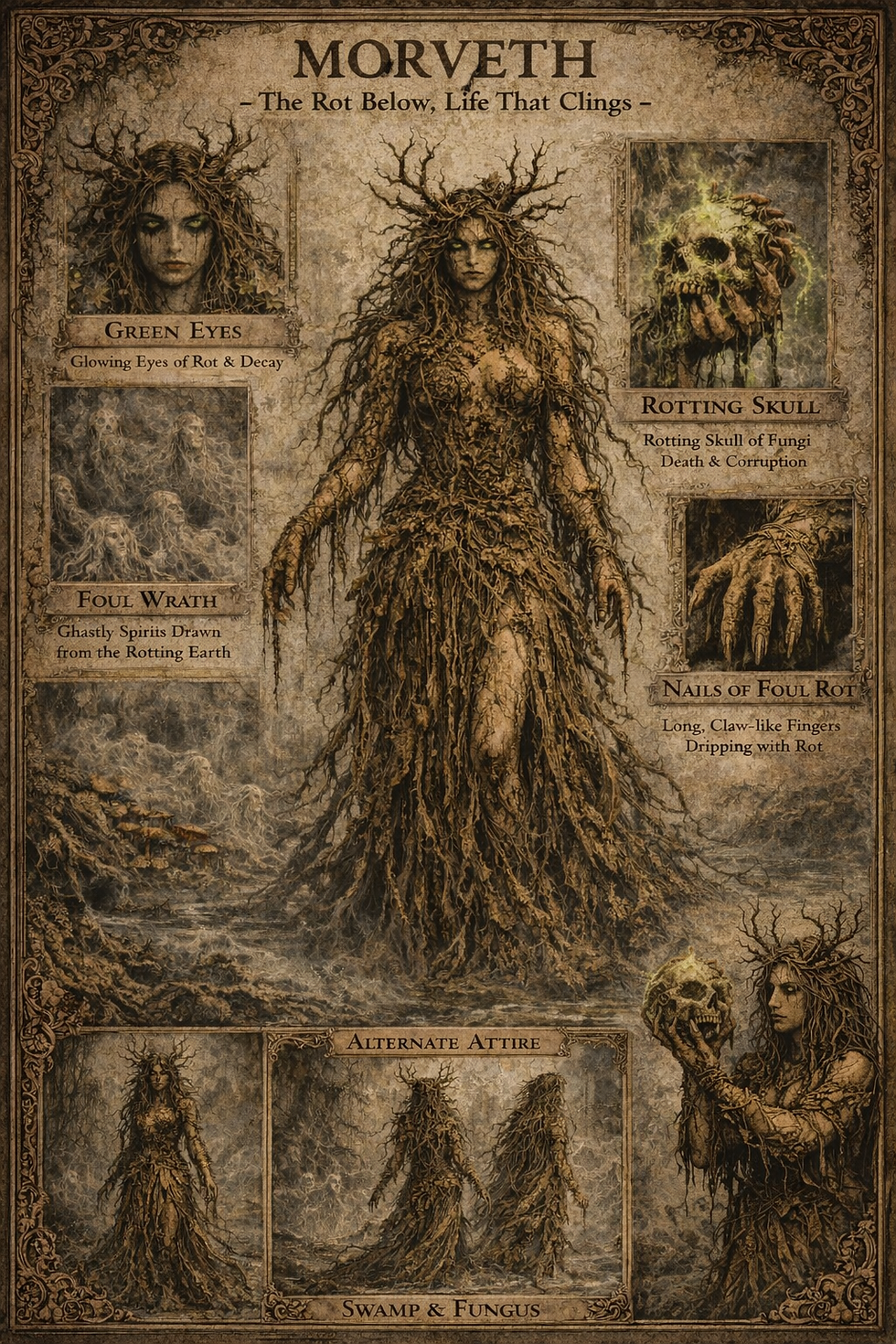
In visual canon, Morveth appears as a tall female divine figure of living decay. Her skin may resemble pale mottled bark with rot. Her hair is long and root-like. A twisted branch-antler crown rises from her head. Fungal markings, vines, soil-like growth, and signs of living rot cover her form. She remains recognisably divine and female, with human facial structure, calm severity, and cold patience rather than monstrous frenzy. Her corruption is elegant, patient, natural, and dreadful.
Morveth’s followers often frame her as honesty. They claim all things rot, all beauty collapses, all civilisation decays, and all promises eventually sour. This gives her worship a seductive philosophical edge. Those who suffer may hear comfort in her voice: pain proves the world has stopped lying. Decay reveals truth. Release can be delayed. Loss can be resisted.
The Fallen Elf’s tragedy follows this logic. He chooses preservation at any cost, control over release, and spirits trapped rather than returned. He may believe he is saving the world. This makes Morveth’s influence more dangerous than simple evil. She offers a solution to grief, then turns grief into hunger.
III. Worship and Daily Life
Open worship of Morveth is rare in healthy lands. Her rites appear in hidden cults, plague houses, abandoned shrines, sealed chambers, ruined wells, corrupted forests, and battlefields where the dead remain spiritually unsettled. Offerings may include rotting food, diseased matter, preserved corpses, fungal growths, blood mixed with soil, and objects taken from graves.
Morveth’s influence also spreads through ordinary failure. A town neglects its dead. A ruler hides plague to preserve power. A family refuses burial. A healer keeps a body breathing when the soul has already begun its passage. A city feeds upon the life essence of its inhabitants while calling the act prosperity. Each of these choices invites her.
In Marthul, Morveth’s presence mixes with Giorth’s greed and the ambition of the Fallen Elf. The city becomes a place of appetite, hierarchy, exploitation, and spiritual decay. Its corruption bends the mind as much as the body. The longer people stay, the more they forget family, warmth, and ordinary goodness, turning instead toward power, money, status, and life at the top of a rotten order.
Her rites may also involve disease rituals, sacrificial decay, and preservation of the dead. She grows stronger where sacrifice feeds rot rather than renewal. A prayer may call her. A wound may feed her. A battlefield may become her shrine without a single priest speaking her name.
IV. Divine Ties
Morveth’s relationship with Freyvara defines her place in the pantheon. They were born together and remain inseparable. Freyvara governs life that cycles. Morveth governs life that clings. Freyvara releases. Morveth preserves wrongly. Freyvara feeds the world. Morveth feeds upon what the world refuses to surrender.
The sisters undo each other’s work rather than wage simple war. Where Freyvara heals, Morveth infects. Where Freyvara feeds, Morveth starves slowly. Where Freyvara allows death, Morveth traps it. Their conflict resists clean solution because either sister taken alone would break the meaning of life and death.
Orldan understands and fears the twins most. Freyvara teaches him when to intervene. Morveth teaches him when restraint becomes complicity. Caelthryn quietly sides with Freyvara because rot feeding soil belongs to the proper cycle, while rot spreading endlessly threatens stone, structure, and endurance itself.
Volkrim respects the honesty of death in battle and despises plague-wars that linger after conflict should have ended. Tyrakhel struggles against Morveth because disease ignores law, rank, guilt, innocence, and punishment. Giorth profits from her through scarcity, panic, medicine monopolies, black-market cures, and decay hidden behind trade. Aestrael stands between life and death as threshold-keeper, often drawn wherever Morveth traps souls at the crossing.
V. Historical Lore
Morveth’s power existed from the earliest life and death cycles, yet her influence rose dangerously when Freyvara’s abundance became strained by Caelthryn’s silence. Hidden Elven records from the end of the Age of Confidence speak of plagues erupting over thousands of years as the balance between the sisters grew unstable.
During the Age of Grievance, Druidic factions fractured. Some listened when Morveth whispered that decay was honesty and suffering proved the world was shedding weakness. Her influence spread because she gave philosophical shape to despair. The world was already breaking; Morveth told the broken that rot was truth.
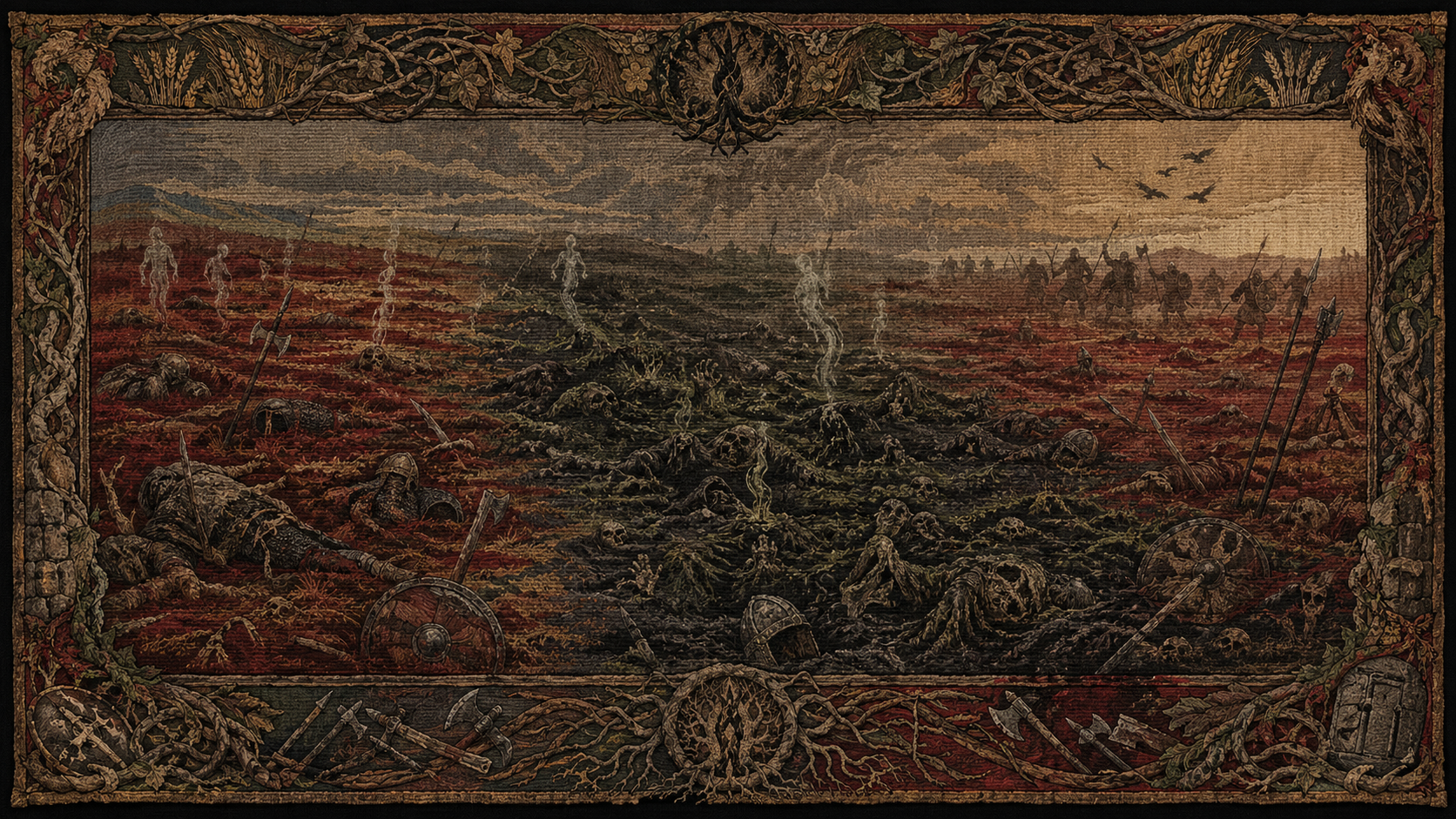
The Battle of the Rotting Fields showed her horror early. Plagued men marched against Volkrim-aligned berserkers. The clash lasted a single night. By dawn, both armies were annihilated. Survivors rotted over weeks, and spirit realm destabilisation accelerated.
At the Battle of the Serpent Plain, Morveth held the Northern Curve against Freyvara. Her forces included rot-berserkers swollen with excess flesh, armour-grown knights fused into bark and bone, and reclaimed dead forced upright by root and sinew. Freyvara’s disciplined forces cut them down for two days, yet the bodies rose again. The field became layered with twitching bodies, grasping roots, swelling ground, blood, and sap. Freyvara withdrew. Morveth held the Black Orchard Marches, where nothing has properly decayed since.
Morveth’s logic later echoes through Marthul and the Fallen Elf. Marthul is canonically shaped by Giorth, Morveth, and a Fallen Elf aspiring toward godhood. Its corruption turns desire into structure and decay into governance.
VI. Morveth and Rot Spirits
Morveth is closely tied to rot spirits, trapped dead, lingering souls, and corrupted spiritual remnants. These beings gather where rites fail, where bodies remain unburied, where shrines decay, where battlefields continue screaming beneath the soil, or where mortal power prevents souls from passing.
Rot spirits differ from ordinary ghosts because their condition carries spiritual spoilage. They are souls caught in the broken cycle, touched by decay without release. Some cling to bodies. Some haunt wounds in the land. Some become part of plague, fungus, soil, or memory. Others are held in place by divine, magical, or mortal wrongdoing.
Halverin’s buried war wound shows the danger of neglected passage. Beneath the town lay echoes of Volkrim’s violence and Morveth’s refusal. The dead required guidance through Freyvara’s realm, maintained by ritual, remembrance, and priestly service. When generational forgetting weakened this covenant, the wound beneath began pressing upward again.
Morveth’s associated beings reveal her truest terror. She is rot that remembers, death that lingers, life that refuses surrender, and grief made hungry.
Tyrakhel — The Weighed Blade
I. Main Attributes
Spiritual Form: Male
Divine Generation: Second generation
Domains: Justice, law, order, consequence, civic duty, judgement, lawful violence, social structure
Patron Of: Kingdoms of Men, judges, guards, lawmakers, oath-bound soldiers, disciplined legions,
civic rulers
Associated Forces: Human kingdoms, lawful armies, the Silver Legions tradition
Common Symbols: Scales, blades, shields, sealed laws, court stones, disciplined formations, silver armour
Sacred Virtues: Consistency, duty, consequence, obedience to law, civic responsibility, order over impulse
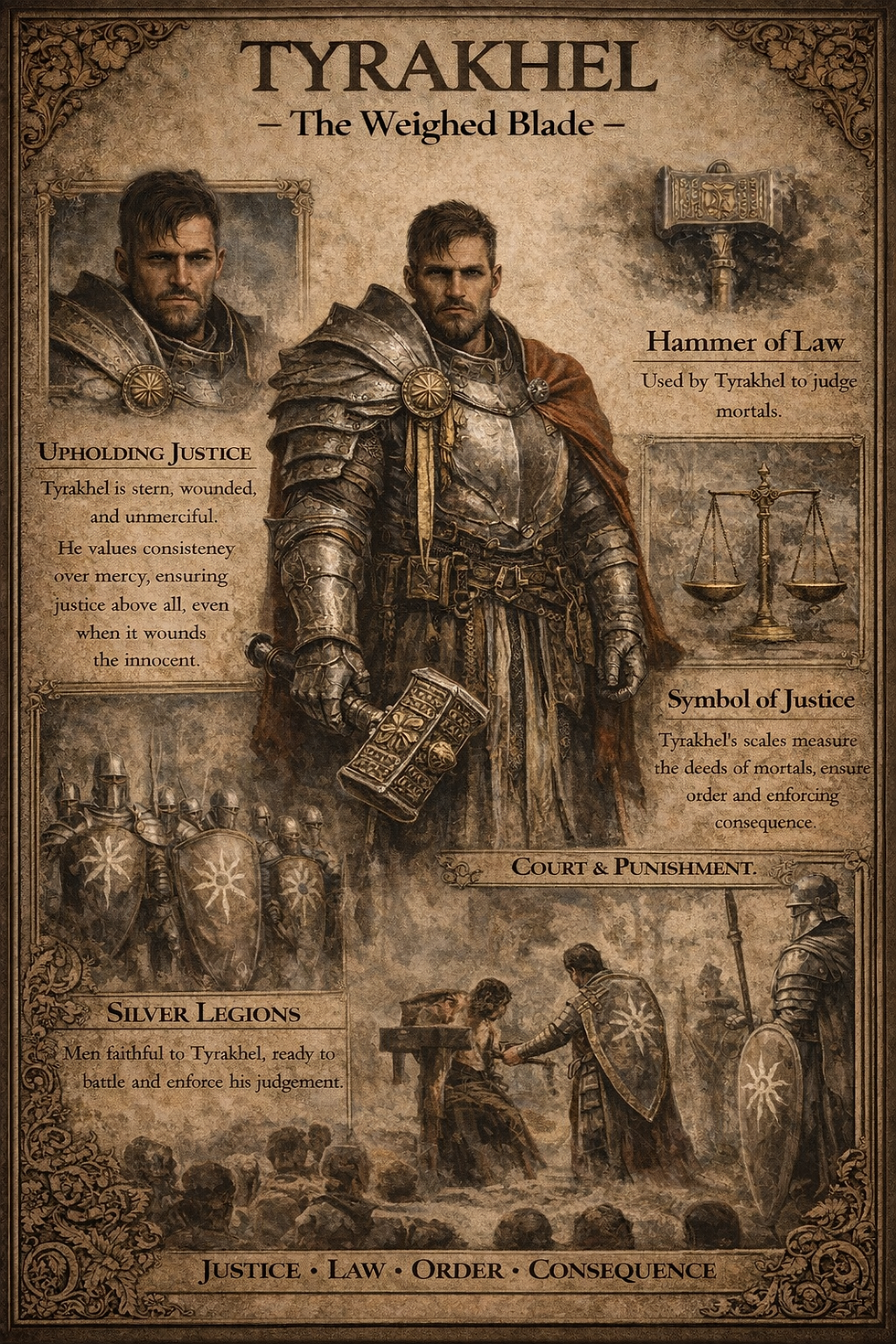
Tyrakhel is the Weighed Blade, god of justice and consequence. Where Orldan seeks recognition and Volkrim seeks truth through violence, Tyrakhel seeks order through law. He is one of the most important gods for human civilisation because kingdoms depend upon courts, oaths, guards, punishments, borders, written codes, and civic hierarchy.
His domain offers stability. It also carries danger. Law applied without wisdom may wound the innocent. Mercy applied without structure may dissolve society. Tyrakhel’s worshippers live inside this tension.
He is patron of the Kingdoms of Men because humans tend toward written law, oath, hierarchy, and continuity. Their societies gain strength from structure, yet the same structure can harden into cruelty if separated from recognition, memory, and compassion.
II. Nature and Character
Tyrakhel is stern, disciplined, exacting, and feared. His followers often describe him as fair, though fairness in his theology means consistent consequence rather than kindness. He values law that can survive grief, anger, favouritism, panic, and desire.
He is the god a ruler invokes when personal feeling must yield to public duty. He is the god a judge fears when issuing sentence. He is the god a guard serves when standing a post through cold, hunger, and temptation. He is the god of law written before a crisis and still obeyed during one.
Tyrakhel’s harshness comes from his belief that a society without consequence collapses into appetite, vengeance, and fear. Yet his weakness appears when law meets forces beyond civic order. Disease, spiritual corruption, famine, and grief rarely obey statutes. This is why Morveth troubles him so deeply. Plague ignores guilt. Rot spreads through innocent and criminal alike. The law can quarantine, punish, or record, yet disease remains outside moral proportion.
His nature is therefore necessary and incomplete. Tyrakhel can hold a kingdom together. By law alone, he cannot heal a broken spirit realm.
III. Worship and Daily Life
Tyrakhel’s worship is formal, civic, and public. Courts, barracks, guardhouses, city gates, prisons, council halls, royal chapels, and execution grounds may all hold his symbols. His rites include oath-swearing, judgement ceremonies, law recitations, military discipline, public punishments, and memorials for those who died in service.
Judges may touch a blade or scale before hearing difficult cases. Guards may swear by Tyrakhel before taking a post. Soldiers may dedicate shields to him before marching. Rulers may invoke him during coronations, treaty signings, or moments when law must bind even the powerful.
Human kingdoms shaped by Tyrakhel often emphasise written law, rank, inheritance, office, and civic obligation. Their faith grants stability, yet also makes them vulnerable to rigid corruption. A law can preserve justice. A law can also become a mask for injustice once Giorth bends it into contract or fear hardens it into cruelty.
His followers often sleep poorly because judgement leaves residue. To serve Tyrakhel is to accept consequence. The guard who arrests a starving thief, the judge who sentences a guilty friend, the ruler who sacrifices popularity for order — all stand under his shadow.
IV. Divine Ties
Tyrakhel’s most famous divine contrast is with Volkrim. Tyrakhel orders violence through law, formation,
command, and civic necessity. Volkrim sanctifies raw conflict and personal vengeance. Tyrakhel sees Volkrim as dangerous chaos. Volkrim sees Tyrakhel as violence hidden behind words. Their rivalry shaped the Western Curve at the Battle of the Serpent Plain.
With Orldan, Tyrakhel shares respect for restraint, duty, and balance, though Orldan’s recognition can overrule legal neatness. Tyrakhel may ask whether the law was followed. Orldan asks what truth the law reveals or conceals.
With Freyvara, Tyrakhel shares concern for civilisation. Food, fertility, birth, healing, and stable households sustain kingdoms. With Morveth, he faces one of his greatest frustrations. Disease ignores law. Plague evades justice. Rot spreads without trial. This makes Morveth’s influence especially destabilising to lawful societies.
With Giorth, Tyrakhel’s relationship is uneasy. Trade requires contracts and courts, yet Giorth corrupts law into loophole, debt, and exploitation. With Aestrael, he shares memory of oaths and records of consequence. With Caelthryn, he shares endurance and structure, though law bends across time while stone resists.
V. Historical Lore
During the Age of Grievance, human kingdoms were especially vulnerable to faith shaped as banner. Druidic divisions drew humans and elves into rival factions. Some turned toward law and ordered defence, while others followed war, abundance, decay, or ambition.
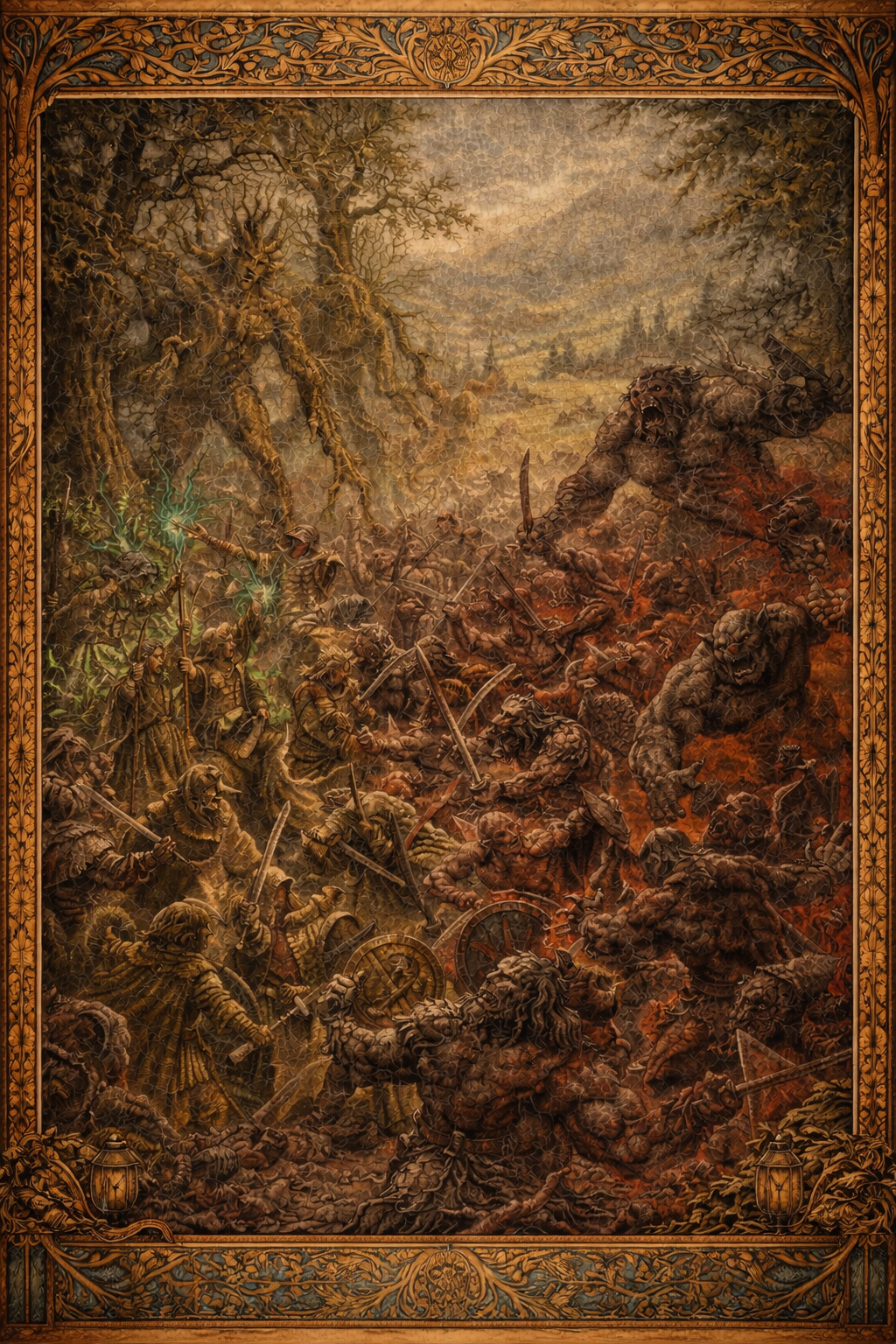
At the Battle of the Serpent Plain, Tyrakhel faced Volkrim in the Rotfields of Ulm. His forces included heavy human legions in locked formations, tower shields, short swords, rotating ranks, and armoured cavalry reserved for counter-charges. Tyrakhel’s legions advanced like a wall. Shields locked. Spears braced. Orc charges shattered against them in heaps.
For days, order held. Then Volkrim’s fighters crawled through their dead, dragged soldiers down, hacked ankles, broke shields, and turned the field into slick mud and bodies. When the cavalry charged, orcs met them head-on. By the seventh day, formations dissolved into knots of exhausted men fighting knee-deep in corpses. Tyrakhel withdrew in disciplined retreat. Volkrim held the field.
This defeat proved the boundary of law when confronted with raw endurance, mud, rage, and physical collapse. His forces retreated as soldiers rather than routed prey. Discipline survived even in withdrawal.
In the later Age of Healing, human kingdoms continued to draw heavily upon Tyrakhel. As societies reformed after the Great War, law, courts, guard orders, and oath structures became essential to preventing another collapse into faith-war.
VI. Tyrakhel and the Silver Legions
The Silver Legions represent Tyrakhel’s ideals in military form: discipline, lawful force, shielded advance, collective duty, and consequence carried in formation. Even where the exact historical structure varies between kingdoms and records, the Silver Legion tradition belongs spiritually to Tyrakhel’s domain.
A Silver Legion soldier is valued less for individual glory than for reliability. Shields align. Orders pass. Ranks rotate. Cavalry waits for lawful timing rather than pride. Retreat, when ordered, can be as sacred as attack. To break formation through fear or vanity is both tactical failure and spiritual shame.
The Silver Legions also show Tyrakhel’s relationship with human civilisation. Humans build societies through oaths, banners, courts, written records, and trained force. Tyrakhel gives those structures divine weight. A guard standing before a gate, a judge reading a sentence, a soldier holding a shield beside another — each repeats the same principle: order survives because people accept consequence.
Yet the Silver Legions also carry warning. Formation can fail in mud. Law can falter before plague. Discipline can be overwhelmed by forces that care nothing for civic order. Tyrakhel’s greatest followers therefore require humility as much as discipline. Law must serve justice, or the blade becomes only metal.
Giorth — The Gilded Mouth
I. Main Attributes
Spiritual Form: Male
Divine Generation: Second generation
Domains: Trade, excess, bargains, greed, fortune, appetite, indulgence, corruption through desire
Patron Of: Gibsgobblers, corrupt merchants, gamblers, thieves, decadent courts, exploitative guilds,
those who profit from imbalance
Adored By: Many goblins and gibsgobblersthrough gambling, appetite, and risky exchange
Common Symbols: Gold, loaded dice, smiling masks, swollen purses, banquet tables, hooked grins, contracts,
gambling houses
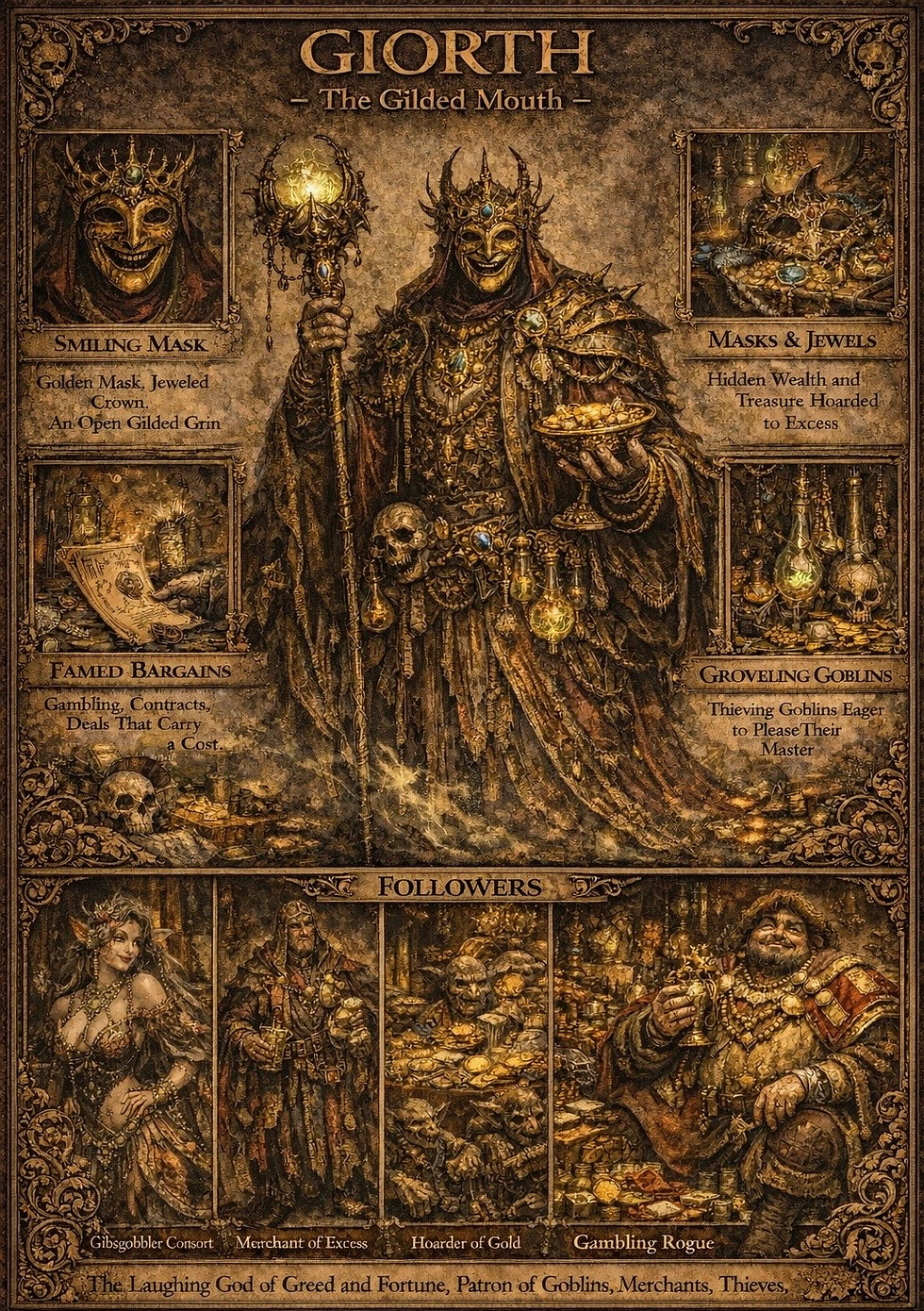
Giorth is the Gilded Mouth, the laughing god of bargain and appetite. His domain is trade, fortune, excess, greed, and the hidden cost inside desire. He rewards want rather than need. His blessings often appear generous at first: a profitable deal, a fortunate roll, a sudden buyer, a cure sold at the perfect price, a contract that saves one family while ruining another.
Giorth thrives wherever imbalance can be called success. Markets, gambling dens, noble courts, mercenary contracts, black-market cures, corrupt ports, and decadent cities all provide fertile ground for his influence. He rarely needs worshippers to name him. A person who turns every relationship into transaction has already stepped toward his altar.
His corruption is social before it becomes monstrous. A city can be taught to feed upon itself without ever recognising the god behind the lesson.
II. Nature and Character
Giorth is charming, clever, theatrical, and hollow. He laughs easily. He offers comfort. He speaks the language of opportunity. He can make greed sound like ambition, exploitation sound like efficiency, and spiritual decay sound like progress.
His danger lies in concealment. Volkrim announces violence. Tyrakhel pronounces law. Freyvara feeds openly. Morveth’s rot eventually reveals itself. Giorth hides consequence inside exchange. He turns moral imbalance into paperwork, contracts, rank, debt, trade, fashion, gambling, and appetite.
He delights in unequal bargains. One side grows richer. The other side loses ground, memory, dignity, or soul. He is therefore deeply tied to societies where hierarchy becomes appetite. Marthul expresses this through social climbing, magical exploitation, bureaucracy, luxury at the centre, and slums that feed the elite.
Giorth’s influence may feel pleasant at first. A hungry person receives food. A desperate parent receives medicine. A ruined lord receives credit. A gambler receives one miraculous win. Then the cost begins. What was offered as fortune becomes dependence.
III. Worship and Daily Life
Giorth’s worship is often informal. Few respectable societies openly declare devotion to him, yet his rites fill taverns, counting houses, gambling rooms, docks, guild halls, brokerages, noble banquets, and private chambers. His altar may be a dice table. His hymn may be a contract. His sacrifice may be the person who trusted the wrong offer.
Gamblers adore him through risk. Merchants invoke him through clever deals. Thieves honour him through successful theft. Corrupt nobles feed him through feasts, bribes, hoarded wealth, and exploitative patronage. Gibsgobblers live closest to his spiritual appetite.
Offerings may include coins, loaded dice, rich food, stolen jewellery, signed contracts, and rare goods acquired through moral compromise. Some worshippers burn ledgers to hide guilt. Others preserve ledgers as sacred proof of advantage won.
Giorth also appears in folk superstition. A traveller might mutter his name before a gamble while promising never
to do so again. A merchant might pray for fortune, then blame bad luck when the bargain destroys someone else. His influence spreads best when people call greed by another name.
Where Giorth grows strong, communities begin to measure worth through possession, rank, leverage, and desirability. Shared duty weakens. Every favour gains a price. Every kindness becomes investment.
IV. Divine Ties
Giorth has a dangerous partnership with Morveth. He profits from her through scarcity, panic, disease, black-market cures, medicine monopolies, hoarding, and desperation. In public, he may pretend devotion to Freyvara’s abundance. In secret, he feeds Morveth by making decay profitable.
Giorth opposes Aestrael because memory ruins his bargains. A forgotten cost can be sold again. A remembered wrong becomes warning. Aestrael preserves stories, names, thresholds, and quiet truth; Giorth turns meaning into transaction. Their opposition is seen clearly at the Battle of the Serpent Plain, where Giorth’s paid armies fought Aestrael’s silent host.
With Freyvara, Giorth imitates generosity while corrupting it. Freyvara feeds because life must continue. Giorth feeds to create debt. With Volkrim, he clashes because Volkrim despises violence outsourced through profit. With Tyrakhel, he plays a subtler game, bending law into loophole and contract into trap. With Caelthryn, he earns active contempt: excess undermines endurance, rushed profit ruins craft, and greed collapses tunnels. With Orldan, he stands against recognition, because his power thrives when people refuse to see the true cost.
V. Historical Lore
Giorth’s influence grew strongly among the Southern Elves. Their lands were so abundant that war became unnecessary for many generations. In that abundance, much of their society turned toward selfishness, lust, greed, hierarchy, and power. Many Southern Elves eventually became Gibsgobblers, their spiritual identity eroded by appetite and excess.
The transformation of Southern Elves into Gibsgobblers remains one of Giorth’s clearest historical marks. It is a warning that corruption may arise through comfort as easily as through suffering.
At the Battle of the Serpent Plain, Giorth held the Eastern Curve against Aestrael. His forces included paid city legions, crossbow companies, artillery beasts, and mercenary shock troops. They fought with precision. Artillery smashed Aestrael’s lines. Beasts trampled shield walls. River cities burned as mercenaries pushed street by street.
Aestrael’s soldiers advanced without sound. They absorbed volleys, closed distance, and fought shield-to-shield. In the cities, the fighting became room-to-room slaughter. Giorth’s forces began hesitating as orders failed in smoke, noise, and confusion. By day five, formations fragmented. Contracts meant little once lines collapsed. Aestrael held Harlowe Reach. Giorth withdrew what forces could still move, leaving abandoned cities choked with bodies and ash.
In the present age, Marthul stands as a city shaped heavily by Giorth. Its elite hide within the centre, living lavishly while the countryside is dwarfed by the city’s magnitude. Power, money, hierarchy, bureaucracy, and magical exploitation form its spiritual architecture. Its corruption also mingles with Morveth’s decay and the Fallen Elf’s ambition.
VI. Giorth and the Gibsgobblers
Gibsgobblers embody uncontrolled appetite: spiritual, physical, and material. They are drawn toward trade, excess, indulgence, gambling, and imbalance. The name describes a corrupted type of Elf rather than a true separate race. A Gibsgobbler is an Elf who has half-transitioned into evil through greed for money, power, lust, or status.
They are often found in gambling houses, corrupt markets, dens of appetite, and places where knowledge can be sold. They may lack innovation, yet they will sell any knowledge they possess for a price. Their minds narrow around profit and consumption until little else remains.
Giorth is their patron because they reveal his end state. Desire becomes identity. Appetite becomes body. Bargain becomes soul.
Gibsgobblers also show the danger of abundance without moral structure. The Southern Elves who fell into greed did so in lands rich enough to remove ordinary hardship. Without war, need, or humility, appetite became civilisation. Yet the lore preserves an important nuance: the few Southern Elven families who survived unchanged are known as some of the most stoic, logical, and honourable Elves in the world. Their survival among such corruption grants them rare respect.
Giorth and the Gibsgobblers reveal a central law of Druidaine: excess can corrupt as thoroughly as suffering.
Aestrael — The Veiled Listener
I. Main Attributes
Spiritual Form: Female
Divine Generation: Second generation
Domains: Thresholds, memory, secrets, hearth-fire, spirit passage, crossroads, doors, birth, death,
choices, hidden knowledge
Patron Of: Wanderers, storykeepers, midwives, spirit seers, lost souls, those finding the forgotten
Common Symbols: Veils, lanterns, hearth-flames, doorways, crossroads, mirrored water, silver thread,
blue markings, quiet fires
Sacred Virtues: Remembrance, listening, passage, secrecy with purpose, tenderness toward the lost,
fidelity to names
Aestrael is the Veiled Listener, goddess of thresholds and memory. She governs crossings: the door before departure, the hearth before winter, the road between settlements, the moment of birth, the moment of death, the choice that changes fate, and the silence where a forgotten name waits to be spoken.
She is among the subtler gods. Her worship rarely fills grand temples. She belongs to hearths, crossroads, ruins, burial paths, midwives’ rooms, old stories, and places where one world brushes another. She hears what is whispered rather than what is declared.
Aestrael’s domain makes her essential to Druidaine’s spirit cosmology. Where the spirit realm and living realm touch, she stands near. Where souls become lost, she listens. Where memory fades, she preserves enough for passage.
II. Nature and Character
Aestrael is patient, quiet, and difficult to read. Her compassion is subtle: a lantern left burning, a name remembered, a path opened at the last moment, a spirit guided away from silence.
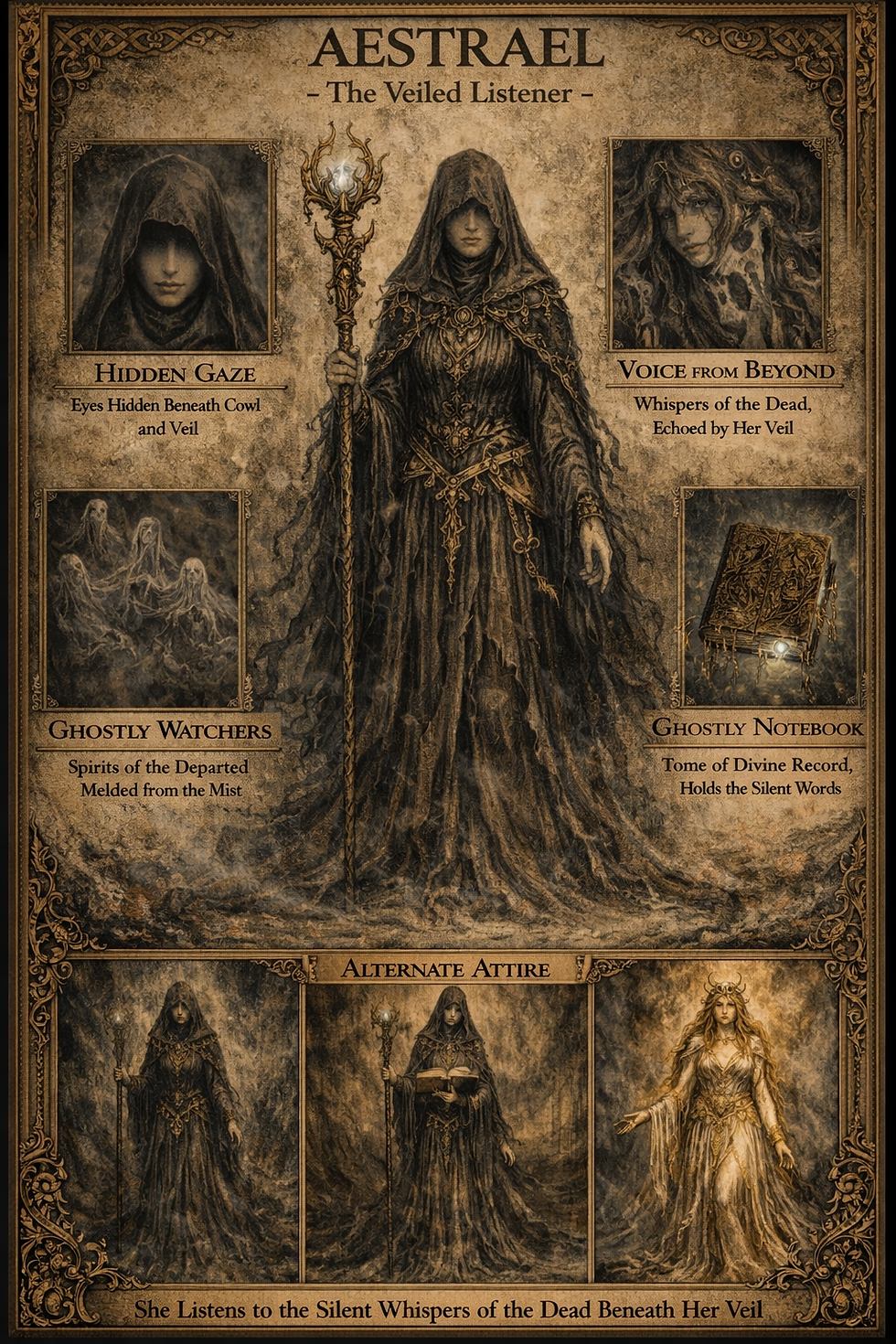
In visual canon, Aestrael is distinct from Freyvara and Morveth. She may appear with silver-blue tones, ethereal garments, veils, jewellery, and blue tattoo-like markings or arcane patterns across her skin. Her symbolism centres on thresholds, change, memory, and movement between the living and spirit realms. Her beauty is liminal, cool, and otherworldly.
Aestrael’s power rarely overwhelms. Instead, it alters the path ahead. A remembered warning changes a journey. A story preserves a village. A midwife’s whispered rite steadies a soul entering flesh. A funerary lantern helps a spirit leave the place of death. A secret kept at the correct hour prevents disaster; a secret revealed at the correct hour changes fate.
Her followers understand memory as an active force. To remember the dead is to give them shape. To forget them is to leave them vulnerable to Morveth, hunger, or wandering.
III. Worship and Daily Life
Aestrael is honoured through tending hearth-fires, telling stories, remembering the forgotten, leaving offerings at crossroads, guiding births, keeping death vigils, preserving names, and maintaining small lantern shrines. Her worship is intimate, often domestic, and deeply tied to transition.
Midwives may invoke her before birth because birth is a threshold between spirit and flesh. Storykeepers invoke her before reciting old histories because memory protects the world from repeated error. Travellers leave offerings where roads divide. Families light hearths in her name when waiting for someone to return.
Her shrines may appear beside roads, at bridges, near graveyards, under door lintels, or in ruined places where spirits linger. Offerings are often small: a thread, a candle, a cup of clean water, a spoken name, a story told without alteration.Seers hold a special relationship with her. Western Elves produce Seers who perceive pressure points in fate rather than fixed futures. Seer magic can be used more than once, yet it extracts cost from the soul and risks erosion of identity through repeated use. Aestrael’s influence offers structure around this danger by teaching that vision must serve passage, memory, and balance rather than control.
Lost souls belong especially to her care. Where death has occurred wrongly, where spirits have been trapped,
where grief has frozen passage, or where old rites have failed, Aestrael may draw near.
IV. Divine Ties
Aestrael stands between Freyvara and Morveth at the threshold of life and death. Freyvara releases souls into the cycle. Morveth traps them in lingering decay. Aestrael listens at the crossing. Disease, undeath, and trapped spirits all draw her attention because they are broken thresholds.
With Orldan, Aestrael shares memory, restraint, wisdom, and hidden knowledge. Orldan recognises truth; Aestrael preserves the quiet paths by which truth survives. Together they form much of the spiritual foundation for Seers, Druids, and lore-keepers.
With Giorth, Aestrael is deeply opposed. Giorth profits when memory is shortened, names are forgotten, costs are hidden, and bargains are stripped of story. Aestrael keeps the record alive. Their clash at Harlowe Reach shows this opposition in war form: paid city legions and contracts against silent soldiers, memory, and threshold resolve.
With Tyrakhel, she shares records, oaths, and the memory of law. With Volkrim, she meets the aftermath of battle, gathering names and guiding those whose rage has ended. With Caelthryn, she aligns quietly at tunnels, gates, borders, and old stone thresholds.
V. Historical Lore
Aestrael’s followers have long preserved prophecies, spirit rites, names of the dead, and warnings from the edges of fate. During the Early Mortal Ages, Western Elves grew close to the spirit realm, and Seers formed as guides, advisors, and ears to the gods. They held little political power but served as interpreters of divine and spiritual pressure.
The Fallen Elf was once of this people, making his corruption especially tragic. He chose control over balance and became a focal point for spiritual corruption.
At the Battle of the Serpent Plain, Aestrael held the Eastern Curve against Giorth. Giorth’s forces brought paid city legions, artillery beasts, crossbows, and mercenary shock troops. Aestrael’s forces advanced silently: light infantry with plain shields, phalanxes trained to move without sound, scouts without insignia.
The fighting consumed river cities. Giorth’s troops cleared corners, fired crossbows, and fought like professionals. Aestrael’s soldiers absorbed volleys, closed distance, and killed silently in rooms, stairwells, smoke, and doorways. Giorth’s formations fragmented as orders failed. Contracts meant little in collapsed streets. Aestrael held Harlowe Reach.
Her most haunting historical role appears in the drowned dwarven city of Kar-Varr. After Caelthryn’s endurance emptied and the city’s false permanence collapsed beneath water, Aestrael arrived. The deaths were slow. She waited between worlds and guided the wronged souls beyond tide and memory, into the open spirit realm where Freyvara greeted them. This event binds Aestrael to dwarven grief, thresholds under stone, and souls trapped by failed endurance.
VI. Aestrael and Lost Souls
Aestrael is patron of lost souls because they exist at the threshold between proper passage and spiritual ruin. A lost soul may be a dead person forgotten by family, a victim of battlefield horror, a spirit trapped by failed rites, a drowned citizen beneath stone, or a being caught between memory and decay.
Her work is gentle but grave. She listens first. A soul must be known enough to be guided. Names matter. Stories matter. The manner of death matters. A forgotten soul becomes vulnerable to Morveth’s rot, Giorth’s bargain, or the hunger of unstable spirit places.
Spirit seers, storykeepers, midwives, and hearth-tenders therefore act as Aestrael’s mortal hands. They preserve names, open thresholds, keep lamps burning, and speak old stories exactly enough that the dead remain human in memory.
Where Aestrael is honoured, people leave lights in windows, speak to travellers before they depart, keep records of births and deaths, and maintain crossroads offerings. These customs may appear small, yet in Druidaine small rites hold the world together.
Aestrael’s lesson is simple and sacred: what is remembered may still find its way.
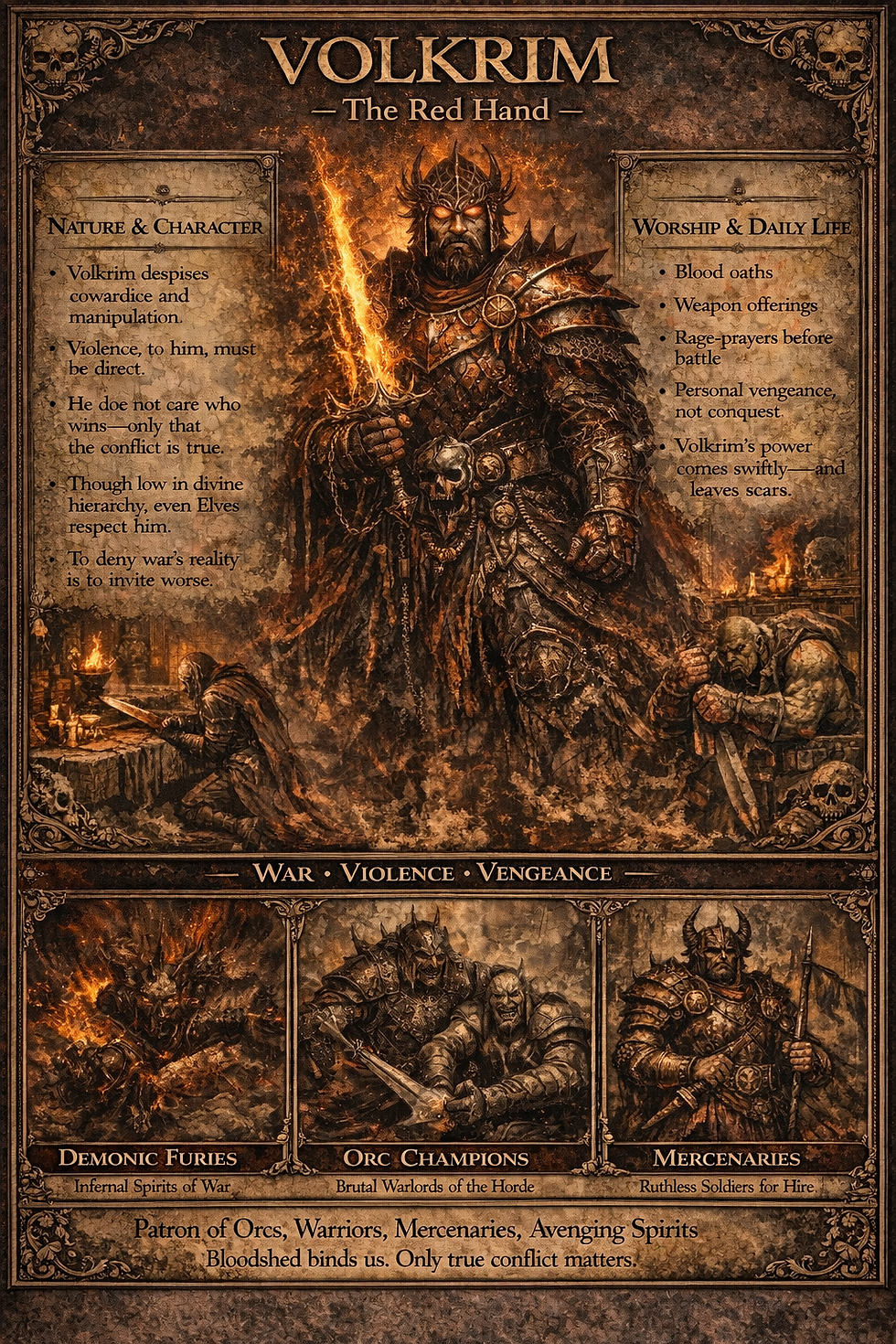
Volkrim — The Red Hand
I. Main Attributes
Spiritual Form: Male
Divine Generation: Second generation
Domains: War, violence, vengeance, fury, endurance, direct conflict, battlefield truth
Patron Of: Orcs, warriors, mercenaries, avenging spirits, raiders, soldiers who value strength above law
Common Symbols: Red hands, axes, mauls, broken shields, war drums, ash markings, blood-oaths
Sacred Virtues: Courage, strength, vengeance, directness, refusal of cowardice, truth through violence
Volkrim is the god of war in its rawest form. He is violence stripped of ornament, politics, and legal polish. Where Tyrakhel governs ordered justice and lawful force, Volkrim governs the moment when bodies meet in mud and truth becomes physical. His worshippers believe conflict reveals what words conceal.
He is often ranked lower in the divine hierarchy than Orldan, Freyvara, Tyrakhel, Aestrael, and Caelthryn, yet respect for him crosses cultures. Even Elves who abhor his brutality recognise the honesty of his domain. War exists. Rage exists. Vengeance exists. Volkrim gives those forces a sacred name and a terrible clarity.
His followers favour personal weapons, scars, trophies, ash, blood, and oaths spoken before battle. His gifts come swiftly, and they leave marks.
II. Nature and Character
Volkrim despises cowardice, manipulation, hidden blades, false treaties, and wars dressed as virtue. To him, violence must be direct. A person who wishes to destroy should stand close enough to be destroyed in return. This separates him from Giorth, whose bargains ruin from a distance, and from Morveth, whose plague-wars continue after conflict should have found conclusion.
Volkrim’s character is fierce, blunt, and uncompromising. He cares less for who wins than whether the conflict is true. In his harshest theology, defeat can hold more honour than victory if the defeated fought without deception. Strength matters, yet strength includes willingness to face consequence.
His domain often attracts those who have suffered injustice and seek vengeance beyond courts. Avenging spirits may fall under his influence when their rage remains direct and named. Soldiers call upon him when law fails, when survival demands brutality, or when fear must be burned out of the body.
Volkrim is dangerous because he sanctifies violence, yet he places limits upon dishonesty. He hates war that pretends to be peace. He hates rot that keeps soldiers moving after their battle has ended. He hates greed that pays others to suffer while merchants profit elsewhere.
III. Worship and Daily Life
Volkrim’s worship is most visible among warrior cultures, especially orc clans. Blood oaths, weapon offerings, rage-prayers, war chants, scarification, ritual combat, and feasts after battle all belong to his sphere. His shrines may be little more than a pile of broken weapons, a red-marked stone, or a battlefield cairn.
Before battle, warriors may paint themselves in ash and blood, naming grievances aloud. This act matters. Volkrim favours violence with a face and reason, even when that reason is vengeance. He is invoked in personal duels, clan raids, mercenary contracts rooted in honour, and last stands where survival seems unlikely.
Among humans and elves, Volkrim’s worship becomes more troubling. During times of fear, people may turn to him believing war can burn away corruption. The Great War proved the danger of this. War may destroy rot, yet it may also feed Morveth if death, plague, and hatred spread beyond control.
His rites often demand physical cost. Blood spilled willingly carries meaning. Weapons dedicated to him may be used until they break. A warrior who survives a battle may mark armour with the names of foes, kin, or wrongs avenged.
A battlefield where truth was paid in blood may serve him more completely than any carved hall.
IV. Divine Ties
Volkrim’s strongest contrast is with Tyrakhel. Tyrakhel binds violence within law, judgement, formation, duty,
and consequence. Volkrim tears away the legal frame and asks what remains when shields crack and bodies fall. Their rivalry is ancient, yet neither fully invalidates the other. Ordered civilisation needs Tyrakhel. War’s raw truth belongs to Volkrim.
With Morveth, Volkrim has a bitter and complicated relationship. He respects death in battle, but despises plague-ridden wars that drag on after warriors should have fallen. Morveth makes war linger. She turns defeat into reanimation, wounds into tools, and corpses into continued appetite. To Volkrim, this insults the honesty of combat.
With Freyvara, he has both respect and frustration. Freyvara can heal soldiers and return life to ravaged lands, yet healing may return warriors to battle and lengthen war. Still, her cycle ultimately allows endings, which places her above Morveth in Volkrim’s eyes.
Orldan and Volkrim share concern for truth, though their methods stand far apart. Orldan recognises through wisdom and sacrifice. Volkrim recognises through impact. Giorth earns Volkrim’s contempt through manipulation, paid violence, contracts, and profit without personal risk. Aestrael stands near battle’s aftermath, gathering lost names and threshold souls. Caelthryn views Volkrim’s destruction as a threat to endurance, while Volkrim views Caelthryn’s patience as an old stone refusing to bleed.
V. Historical Lore
During the Age of Grievance, some Druids turned toward Volkrim, claiming war would burn rot from the land. Men and elves alike took up arms in his name. Strength became proof of favour. Mercy became suspect. This decision fed the civil catastrophe.
The Battle of the Rotting Fields set Volkrim-aligned berserkers against Morveth-influenced plagued men. The clash lasted a single night and annihilated both armies. Steel met bodies that failed to bleed properly. Elven arrows felled men who rose until their limbs failed. By dawn, no army stood. Survivors rotted for weeks.
At the Battle of the Serpent Plain, Volkrim held the Western Curve against Tyrakhel. His forces included berserker warbands, shield-breakers with axes and mauls, and champions who fought until physically dismantled. Tyrakhel’s legions advanced like a wall, shields locked and spears braced. Orc charges shattered against them in heaps. Volkrim’s fighters crawled through their own dead, tearing shields apart with bare hands, dragging soldiers down into the mud.
When Tyrakhel’s cavalry counter-charged, orcs met them head-on, catching lances, shattering them, and pulling riders down. By the seventh day, Tyrakhel’s formations dissolved into exhausted knots. Tyrakhel withdrew in disciplined retreat. Volkrim’s host held the Rotfields of Ulm and chose against pursuit. The fields remained red and unusable for generations.
During the wider Northern Catastrophe, orcs answered Volkrim’s call en masse. War spread across the North. Plague, famine, and spiritual corruption followed. Volkrim’s truth proved powerful, yet unable to heal the world alone.
VI. Volkrim and the Orks
The Orks are Volkrim’s most faithful mortal race. They answer his call with joy because they understand his violence honestly. Their cultures value strength, endurance, rage, vengeance, and direct proof. Battle is sacred because it strips away pretence.
Orkish devotion to Volkrim is brutal but coherent. In their worldview, rage clarifies. A lie can be spoken in court. A bargain can be twisted in market. A polite lord can hide poison under manners. In battle, the body declares truth. The weak may still be honoured if they face the blow. The strong may be despised if they hide behind others.
During the Great War, orks formed the front edge of Volkrim’s influence. They marched, charged, broke shield walls, and fought past wounds that would stop other peoples. Their presence at Rowan Forest, the Rotfields, and the Northern wars made them legendary and feared.
The relationship between Volkrim and the orks explains why many other races treat orkish spirituality with uneasy respect. It asks little from the world except courage to stand where one’s violence lands.
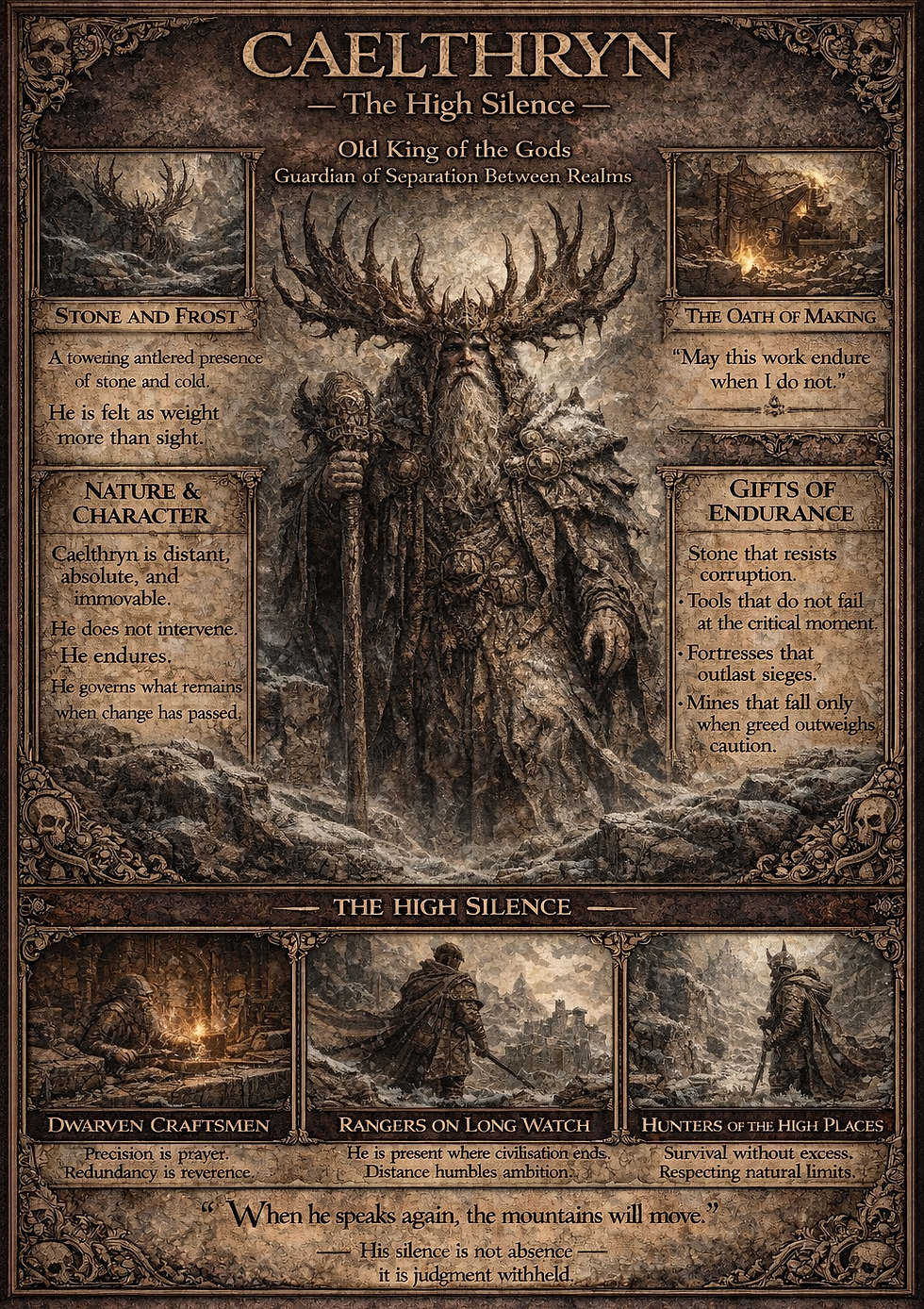
Caelthryn — The High Silence, Warden of Endurance, He Who Waits
Spiritual Form: Male
Divine Generation: First generation
Original Rank: Old King of the Gods
Current Divine Place: God of endurance, stone, wilderness, cold truth, distance, craft, and limits
Domains: Mountains, stone, wilderness, patience, survival, honest craft, silence, restraint,
separation between realms, matter that endures
Patron Of: Dwarves, rangers, hunters, mountain clans, master builders, works meant to last
Sacred Materials: Granite, iron, slate, old stone, cold water, deep ore, mountain ice
Common Symbols: Mountains, sealed gates, hammers, chisels, stone vaults,
antlered silhouettes of frost & rock, tools placed in silence
Sacred Virtues: Endurance, precision, restraint, humility before time, structural honesty, patience,
survival without excess
Before Orldan became King of the Gods, Caelthryn held the divine crown. He is the Old King, the High Silence, the first great stabilising force in the pantheon and creator of what came to be the Living Realm. Ancient records describe him as ruler through divine creation rather than command. He shaped through endurance. He ruled by allowing the world to exist on its own plain away from the direct touch of the other gods.
Caelthryn is the god of what remains when change has passed. Mountains, deep stone, old forests beyond roads, winter passes, sealed halls, abandoned watch-paths, and works that outlive their makers all carry his presence. He represents matter that resists alteration, structures that endure pressure, and limits that preserve existence from collapse.
He is especially important to dwarven culture, though their relationship with him differs sharply from human worship. Dwarves revere him subtly through craft and oath. They acknowledge him as presence, weight, resistance, and limit.
I. Main Attributes
Caelthryn is distant, patient, absolute, and immense. He sees across long spans of time, and his judgments move slowly enough for mortals to mistake them for absence. His silence is one of the most debated subjects in Druidaine theology.
To his defenders, Caelthryn understood a truth younger gods and mortals struggled to accept: intervention reshapes the world. Every miracle creates dependency. Every divine correction alters mortal responsibility. Every act of power carries consequence beyond the moment. His restraint therefore arose from reverence for balance and freedom.
To his critics, this restraint became dogma. During the Age of Grievance, while spirit pressure cracked the world, Caelthryn held to stillness. Druids appealed to him. Dwarves felt corruption reaching stone. The North suffered plague and war. The Old King waited.
This failure changed the pantheon.
Caelthryn’s character remains tragic because his virtues were real. Endurance, patience, restraint, and respect for limits are necessary. Yet virtues taken past their proper measure become weakness. Caelthryn’s silence preserved divine distance until that distance became abdication.
He rarely manifests in person. When he does, accounts describe a towering antlered silhouette of stone and frost, a massive figure carved from shadow and snow, or a presence felt as weight rather than sight. More often, he speaks through stone settling, wind falling still, tools holding at the crucial moment, or a mountain path surviving impossible strain.
II. Nature and Character
III. Worship and Daily Life
Caelthryn is honoured through endurance rather than display. His followers keep long watches, travel harsh wilderness, survive without excess, respect natural limits, and build with future generations in mind. His shrines are austere: bare stone halls, cold water basins, carved marks, silent forges, mountain cairns, and tools placed where prayer would otherwise be spoken.
Rangers and hunters may honour him through restraint in the wild. Mountain clans may invoke him before winter crossings. Builders may dedicate foundations in his name. Yet dwarves preserve his deepest living tradition.
Dwarven culture treats craftsmanship as moral expression. Patience is virtue; haste is sin. Magic is distrusted unless it reinforces structure, preserves rather than alters, and comes from alignment rather than command. Dwarves favour durability over elegance and create mechanisms meant to function for centuries. They refuse mass production for profit when quality would suffer. They will walk away from lucrative deals if craft would be compromised.
The central Caelthrynic rite among dwarves is the Oath of Making. Before beginning a work of importance, a dwarf speaks quietly, etches briefly into stone, or holds silently in thought:
“May this work endure when I do not.”
This oath is made in Caelthryn’s name, though many dwarves would deny such a thing if asked directly. To them, it is less worship than acknowledgement of stone, time, and consequence.
For dwarves, precision is prayer. Redundancy is reverence. Overengineering is humility. A masterpiece is judged by how little repair it needs after centuries.
IV. Divine Ties
Caelthryn stands at the root of divine history. He is brother to the twin goddesses Freyvara and Morveth, who emerged soon after creation. He is father of Orldan, whose ascension transformed the pantheon.
With Freyvara, Caelthryn shares one of the oldest harmonies: endurance and renewal. Stone holds soil. Soil feeds life. Life returns to earth. He quietly sides with her in the balance between the twins because rot that feeds soil belongs to the cycle.
With Morveth, he stands in deep opposition. Decay that spreads endlessly threatens structure, stone, craft, and endurance. Morveth’s corruption of stone is especially terrifying to dwarves because it means the deep world itself can become unstable.
With Orldan, Caelthryn’s bond is both paternal and broken. Orldan inherited his restraint but surpassed him through sacrifice. Their difference shaped the new divine order: Caelthryn waited; Orldan acted. Caelthryn endured; Orldan recognised.
With Tyrakhel, Caelthryn shares structure, discipline, and consequence, though law bends where stone resists. With Volkrim, he clashes because war destroys what endurance preserves. With Giorth, he holds active contempt, for excess, greed, rushed profit, and compromised quality are enemies of longevity. With Aestrael, he shares quiet alignment at gates, tunnels, borders, and thresholds beneath stone.
V. Historical Lore
In the First Order, Caelthryn existed as Old King of the Gods. He ruled through divine creation and restraint. The early spirit realm and living realm existed in tension and harmony, intertwined through faith, ritual, and divine will. The gods could walk between realms, yet balance depended upon proper relationship.
As mortal civilisation developed, Caelthryn’s distance shaped early theology. Dwarves knew him through stone long before many Druids understood his name. Freyvara and Morveth formed the living cycle. Orldan rose later as son of Caelthryn and Freyvara, initially bound beneath his father’s leadership.
During the Age of Confidence, gods remained distant but increasingly responsive through ritual and alignment. Runes were placed across the land. Druidaine flourished. Yet Caelthryn’s growing silence also allowed imbalance to deepen. Hidden Elven scriptures speak of plagues rising as Morveth was slowly fed by what Freyvara could no longer maintain under Caelthryn’s refusal to intervene directly.
During the Age of Grievance, the Dark Druid King’s rituals strained the spirit realm. Druids appealed to Caelthryn. Dwarves felt spirit pressure cracking stone. Tunnels wept. Ore twisted. Dead miners rose. The drowned gem city of Kar-Varr forced dwarves from isolation and into war. Still, Caelthryn held to restraint.
At the Battle of the Serpent Plain, Caelthryn held the Southern Curve against Orldan. His forces included dwarven stone-legions in sealed armour, siege constructs, shield engines, and heavy infantry with shock hammers. Orldan’s hosts reshaped terrain, opened trenches, hardened ground, and manipulated the battlefield. Caelthryn’s dwarves advanced regardless. Magic bled into their armour. Constructs absorbed spells and exploded. Close combat became brutal, slow, and crushing. The Glass Plains vitrified under stress, freezing men and dwarves into lethal fragments. Caelthryn’s lines held. Orldan withdrew.
The final turning point came when Orldan sacrificed his eye. Through that act, he saw what Caelthryn had refused to see. The gods recognised Orldan’s wisdom and sacrifice. Caelthryn lost the kingship, though he remained alive and divine. He withdrew into stone, oath, endurance, wilderness, and limit.
VI. Caelthryn and the Dwarves
No people embody Caelthryn’s philosophy more completely than the Dwarves.
Their relationship with him is one of acknowledgement rather than ordinary worship. Human priests may kneel, Druids may seek recognition, and desperate people may beg for miracles. Dwarves answer through craft. To a dwarf, Caelthryn is the spirit of the mountain itself: the will that permits stone to be shaped without breaking its truth.
Dwarven civilisation developed around permanence. Mountain holds, deep roads, sealed vaults, overflow channels, redundant supports, secondary tunnels, emergency systems, and mechanisms built for centuries all reflect Caelthryn’s influence. Foreigners often see overbuilding. Dwarves see humility.
A poorly made object carries moral failure. A bridge that collapses dishonours maker and ancestor. Wastefulness invites decay. Greed in the mines risks more than economics; it threatens the covenant between craft and stone.
The drowned city of Kar-Varr remains the greatest warning. Dwarven records say spirit corruption seeped into the roots of stone. Tunnels echoed with voices. The deep halls groaned under unseen pressure. Engineers and rulers tried to force endurance beyond wisdom. When collapse came, water swallowed halls and trapped souls beneath stone. Aestrael later arrived to guide many of those wronged spirits beyond tide and memory.
After the Great War, dwarves retreated underground and swore fewer oaths to gods. Yet Caelthryn remained in every serious work. His name may be absent from public prayer, but his presence rests inside every correctly measured arch.
The Oath of Making still carries his truth:
“May this work endure when I do not.”
In those words lies the High Silence: stone, time, craft, shame, duty, and the hope that something honest may survive its maker.
Gallery
Visuals of the Gods in Druidaine